Case Details
Cable television networks originally provided only video services, but with technological advancements, they have evolved into internet access.
It also refers to the system that uses a transmission medium to distribute television signals. Cable television network types include:
- Traditional cable television networks
- Hybrid fiber-coaxial cable networks
1. Traditional cable television networks
This type of network originally distributed broadcast video signals to areas with poor or no signal. Traditional cable television networks are also called community antenna television because the antennas, located at the top of buildings, receive signals from television stations and then distribute them to the community via coaxial cable. Below is a diagram of a traditional cable television network.
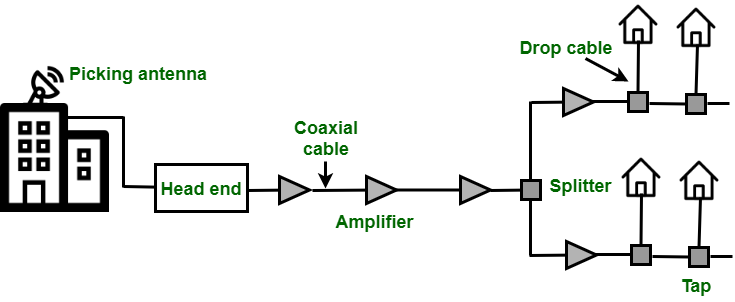
The cable television office, called the headend, receives video signals from broadcast stations and feeds them into coaxial cable. As signals weaken over distance, amplifiers are installed in the network to regenerate them. In this network, over 35 amplifiers are installed between the headend and the subscriber end. At the other end of the cable television network, a signal distributor is installed to distribute the signal, connecting to the subscriber end via drop and inlet cables. Communication in this network is unidirectional. Video signals travel downstream from the headend to the subscriber end.
2. Hybrid Fiber-Coax Network
Hybrid fiber-coax is a second-generation cable network that uses a combination of optical fiber and coaxial cable. The transmission mode is fiber-node, or fiber-mode. A schematic diagram of an HFC network is shown below:
The regional cable headend (RCH) serves nearly 400,000 subscribers. Signals are sent via fiber-optic cables to fiber nodes, where they are modulated and demodulated by distribution hubs. The fiber nodes separate the analog signals so that the same signal can be sent down each coaxial cable. Each coaxial cable serves approximately 1,000 subscribers. Communication is bidirectional.
Advantages of Cable TV Networks:
- Cable TV service is stable.
- Relatively affordable.
Disadvantages of Cable TV Networks:
- The single-vendor supply creates a monopoly.
- Privacy is compromised when our TV cables connect to the internet or the World Wide Web.


