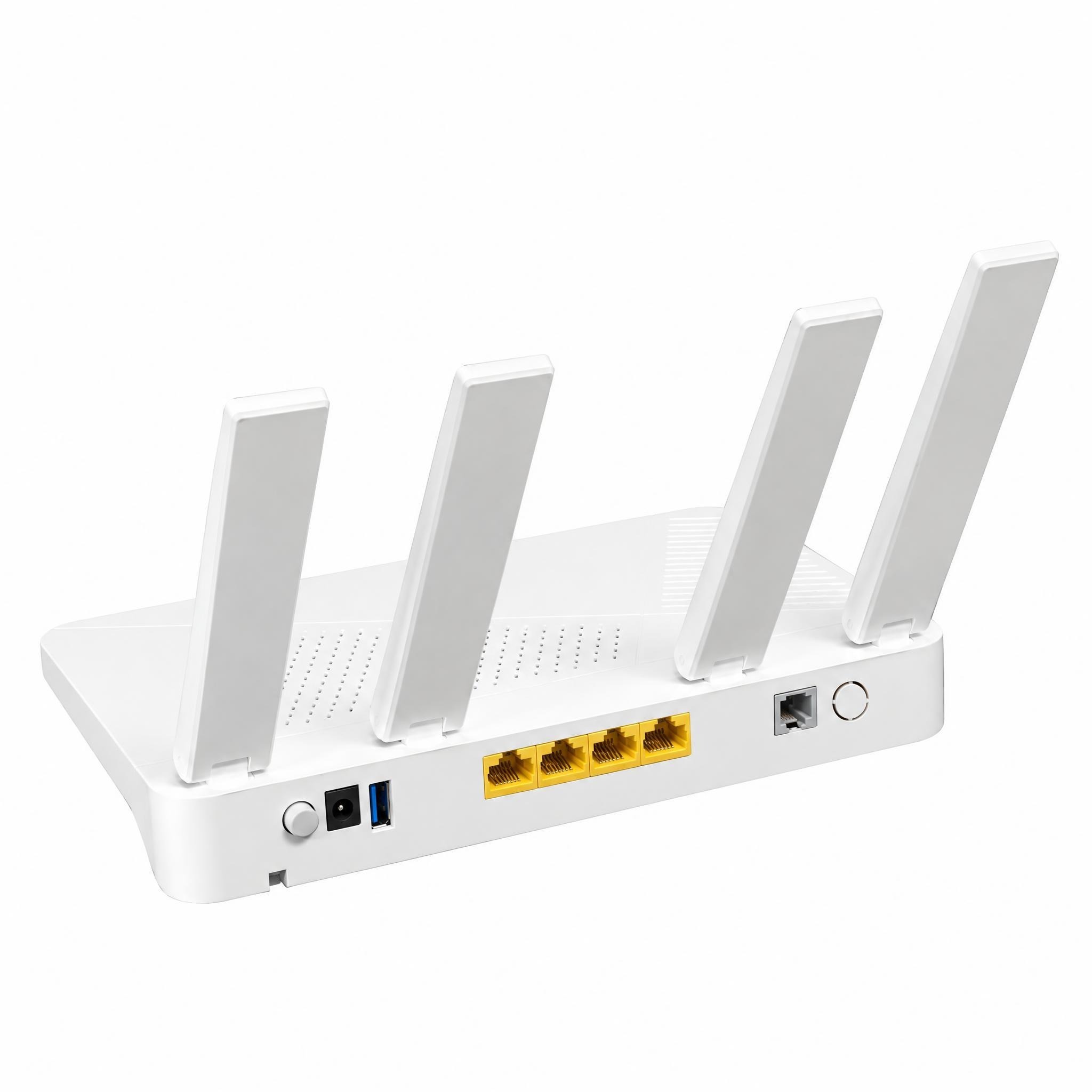
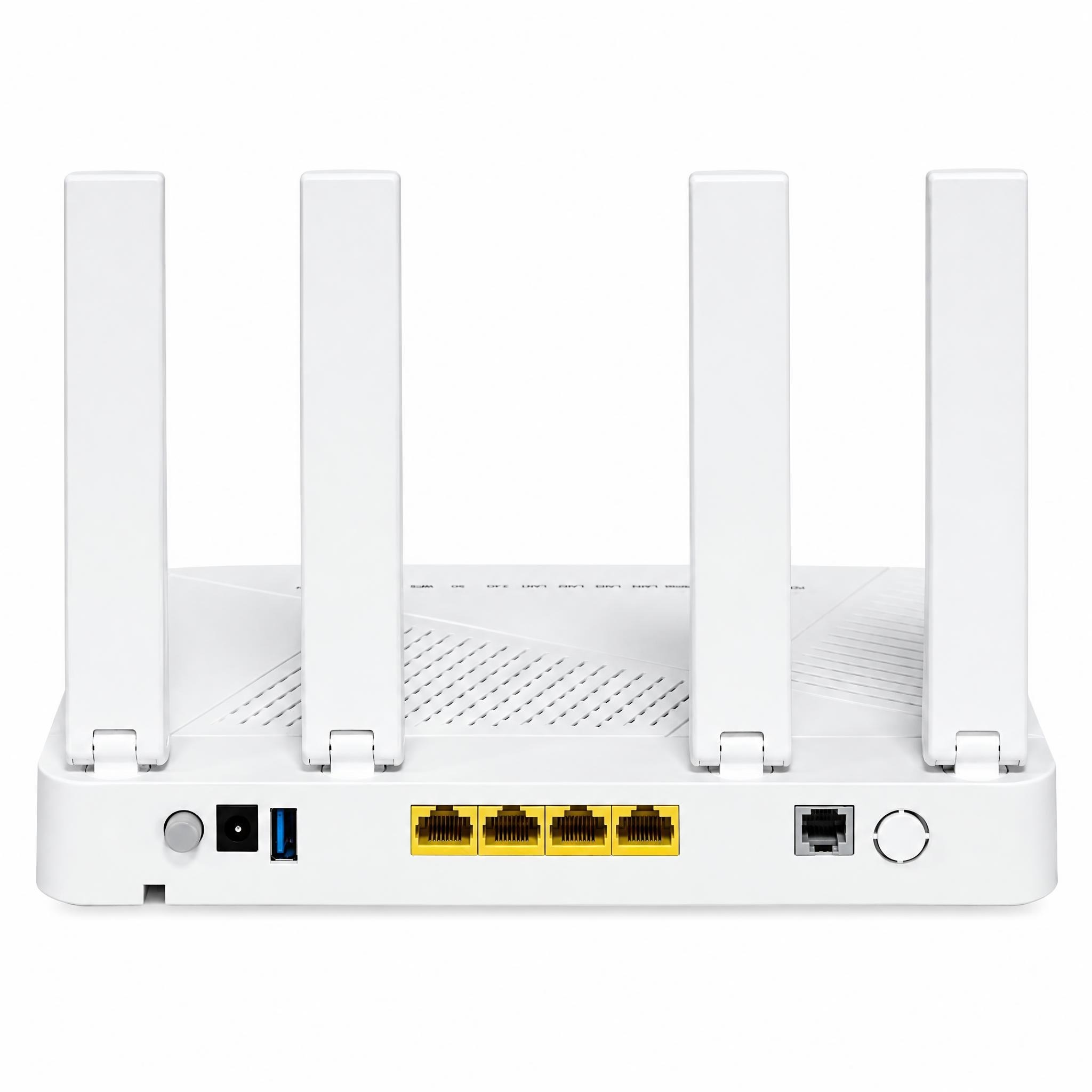
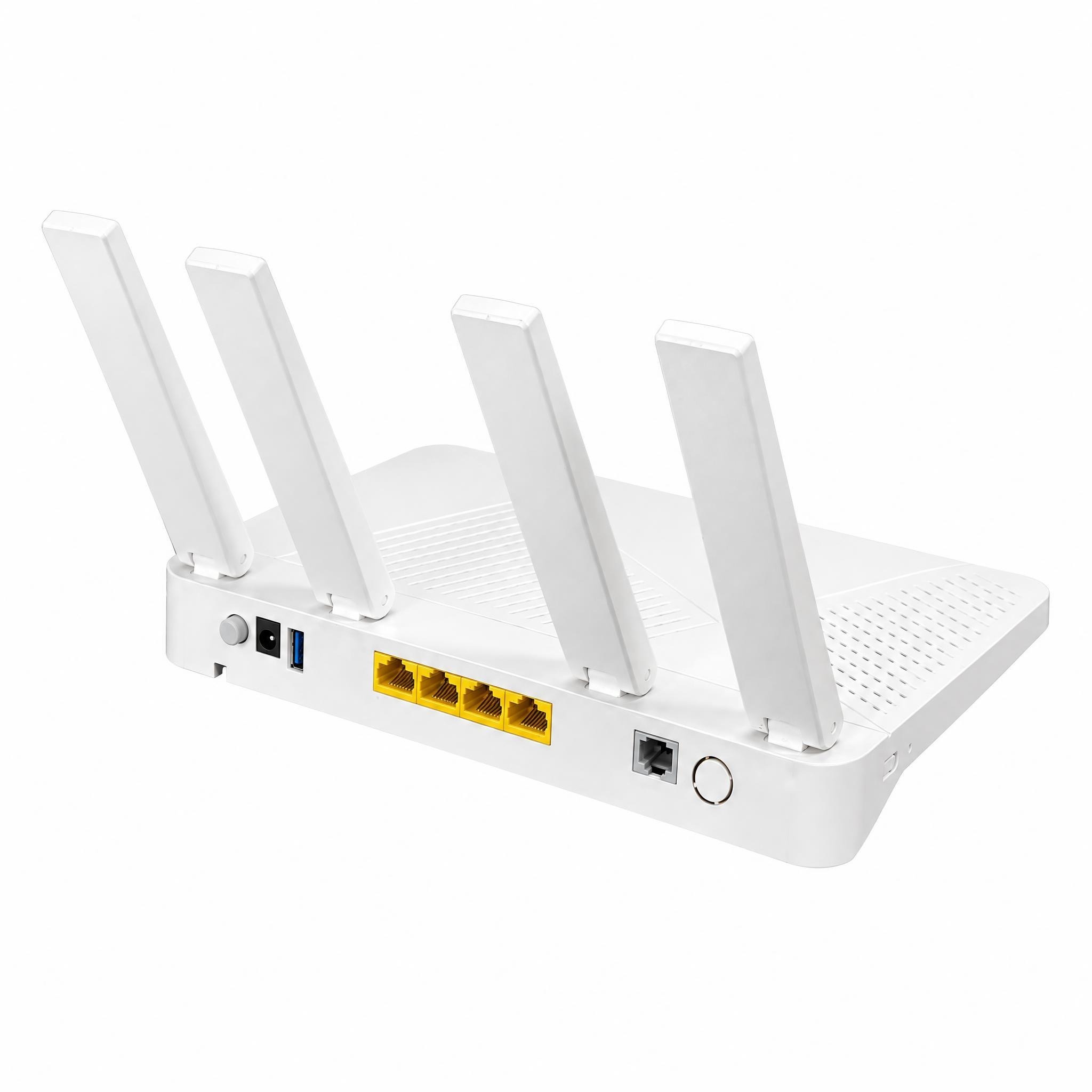
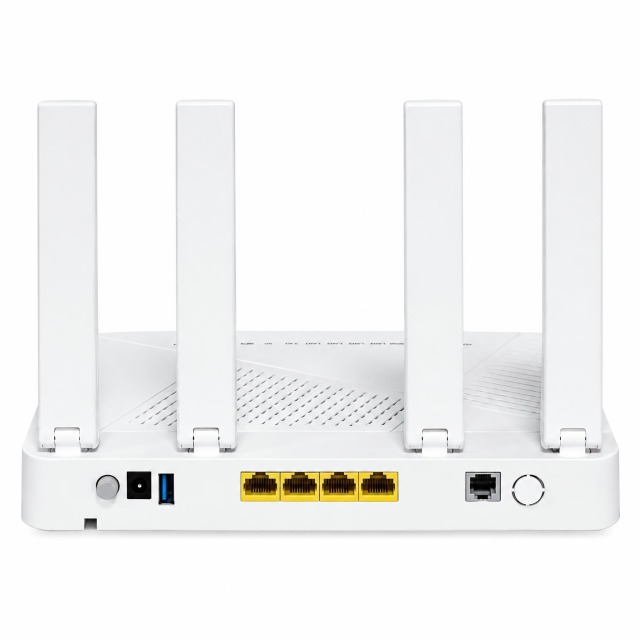
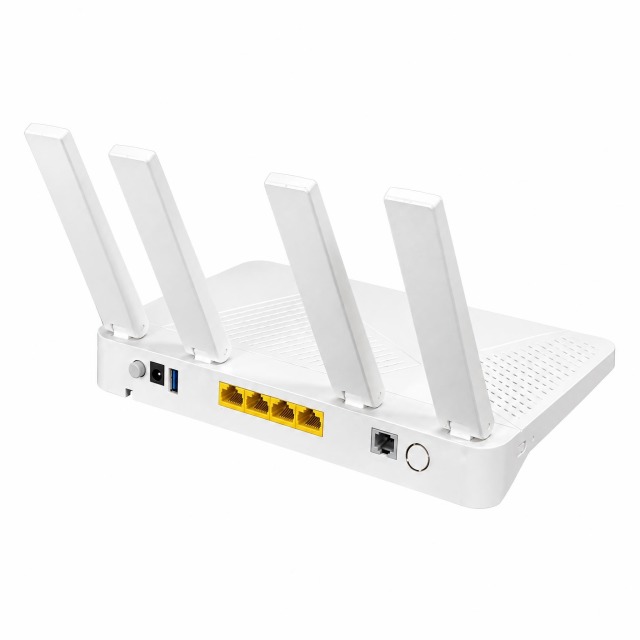
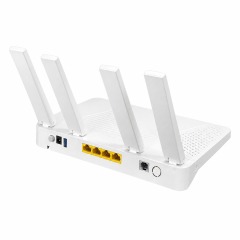
HT3000T is an AX3000 Wi-Fi 6 XPON ONT featuring dual-band wireless connectivity, 2/4 Gigabit Ethernet ports, and one POTS interface for SIP-based VoIP services. Supporting GPON/EPON networks, automatic PON mode switching, and OEM firmware customization, it provides an integrated broadband and voice access solution for ISPs and telecom operators.
The MF-Telecom HT3000T is a high-performance AX3000 Wi-Fi 6 XPON ONT designed for fiber broadband and fixed-line voice service delivery.
Powered by a Realtek (RTL) chipset, HT3000T combines GPON/EPON access technology, dual-band Wi-Fi 6 wireless connectivity, Gigabit Ethernet ports, and an integrated POTS interface.
The POTS interface supports SIP-based VoIP services, allowing operators to provide traditional telephone connectivity through their fiber broadband infrastructure.
With four external 5 dBi antennas, HT3000T delivers reliable wireless connectivity for modern residential networks. Its HGU functionality and advanced Layer 2/Layer 3 capabilities make it suitable for various ISP network architectures.
HT3000T also supports OEM firmware customization and pre-configuration, helping service providers deploy customized broadband and voice services across their subscriber networks.
Key Features
1. AX3000 Dual-Band Wi-Fi 6
Supports IEEE 802.11a/b/g/n/ac/ax.
2.4 GHz and 5 GHz dual-band wireless connectivity.
2×2 MIMO.
Four external 5 dBi high-gain antennas.
High-speed wireless access for connected home devices.
2. Integrated POTS Interface for VoIP
One POTS telephone interface.
Supports SIP protocol.
G.711a/G.711u/G.722/G.729 audio coding.
Echo cancellation, VAD/CNG and DTMF relay.
T.38 fax support.
Caller identification and call waiting.
Call transfer, call hold and three-party conference.
3. GPON / EPON Dual-Mode Access
Supports GPON and EPON networks.
Automatic EPON/GPON mode switching.
Up to 20 km transmission distance.
HGU functionality.
4. Gigabit Ethernet Connectivity
Optional 2GE or 4GE RJ45 ports.
10/100/1000 Mbps adaptive Ethernet.
Supports wired home networking and broadband devices.
5. Advanced Network Management
IPv4/IPv6.
PPPoE, NAT and DHCP.
VLAN 802.1Q/802.1ad.
IGMP Snooping/Proxy.
Firewall and ACL.
Port mapping and loop detection.
6. OEM Firmware Customization
Customized SIP and network configurations.
Pre-configuration for ISP deployments.
Customized wireless SSID and settings.
OEM branding and firmware options.
VoIP & Voice Service Capabilities
HT3000T integrates a POTS interface for delivering SIP-based voice services over fiber broadband networks.
Its voice capabilities include:
SIP protocol support.
Multiple audio codec options.
Echo cancellation.
T.38 fax.
Caller identification.
Call waiting and call holding.
Call transfer and three-party conference.
This makes HT3000T suitable for operators who want to maintain fixed-line telephone services while upgrading subscribers to fiber broadband.
OLT Compatibility
HT3000T supports GPON and EPON access technologies and can be deployed with compatible PON OLT infrastructure.
For SIP voice services, operators can configure the device according to their voice platform, SIP server, and network requirements.
MF-Telecom can assist with firmware pre-configuration and compatibility verification before deployment.
Application Scenarios
FTTH broadband and VoIP integrated networks.
Fixed-line telephone service providers.
ISPs offering broadband and voice packages.
Residential broadband network upgrades.
Telecom operators migrating legacy telephone subscribers to fiber.
Q1: What is the difference between HT3000 and HT3000T?
HT3000T includes one POTS interface for SIP-based VoIP telephone services. HT3000 does not include the POTS interface.
Q2: Does HT3000T support SIP?
Yes. HT3000T supports SIP protocol and multiple voice codecs, including G.711a/u, G.722 and G.729.
Q3: How many telephone ports does HT3000T have?
HT3000T provides one POTS telephone interface.
Q4: Does HT3000T support fax services?
Yes. It supports T.38 fax functionality.
Q5: Can the SIP configuration be customized?
Yes. Firmware and SIP-related parameters can be pre-configured according to the ISP's requirements and supported firmware capabilities.
The indicator lights of the ONT are important indicators for judging the working status of the ONT. The table below shows the meaning of the different states of our company's ONT general indicator lights to help customers verify whether the ONT is working properly and troubleshoot common problems.
Indicator
Status
Description
Power
Steady on
The ONT is powered on.
Off
The power supply is cut off.
PON/LOS
See the following table
LAN1-LAN4
Steady on
The Ethernet connection is in the normal state.
Blinking
Data is being transmitted over the Ethernet port.
Off
The Ethernet connection is not set up.
TEL
Steady on
The ONT is registered with the softswitch but no service flows are transmitted.
Blinks twice a second
The ONT is registered with the softswitch, and data is being transmitted on the port.
Blinks once every 2 seconds
The ONT fails to be registered with the softswitch.
Off
The POTS port is disabled.
WLAN
Steady on
The WLAN function is enabled.
Blinking
Data is being transmitted over the WLAN port.
Off
The WLAN function is disabled.
WPS
Steady on
The WPS function is enabled.
Blinking
A Wi-Fi terminal is accessing the system.
Off
The WPS function is disabled.
CATV
Steady green
The CATV function is enabled and CATV signals are received.
Off
The CATV function is disabled or CATV signals are not received.
Status No.
PON Status
LOS Status
Description
1
Off
Off
The ONT is prohibited by the upper-layer device or blinks abnormally. Contact the service provider for help.
2
Blinks twice a second
Blinks twice a second
3
Blinks twice a second
Off
The ONT attempts to set up a connection with its upper-layer device.
4
Steady on
Off
A connection is set up between the ONT and its upper-layer device.
5
Off
Blinks once every 2 seconds
The ONT is not connected to fibers or does not receive optical signals.
6
Blinks once evey 2 seconds
Blinks once every 2 seconds
The hardware is faulty.
The following tables provide descriptions of the functions and performance of ports commonly found on ONT products.
GPON Port Specifications
Parameter
Specifications
Transmission rate
Rx: 2.488 Gbit/s Tx: 1.244 Gbit/s
Connector
SC/PC
Maximum transmission distance
20
Standard compliance
ITU-T G.984.2 CLASS B+
Center wavelength
Tx: 1310 nm Rx: 1490 nm
Tx optical power
0.5 dBm to 5.0 dBm
Extinction ratio
> 10 dB
Receiver sensitivity
-27dBm ~ -29dBm
Overload optical power
-8 dBm
XG-PON port specifications
Parameter
Specifications(Class N1/N2a/E1)
Transmission rate
Rx: 9.953 Gbit/s Tx: 2.488 Gbit/s
Connector
SC/UPC
Maximum transmission distance
20
Standard compliance
ITU-T G.987.2
Center wavelength
Rx: 1577 nm Tx: 1270 nm
Tx optical power
2.0 dBm to 7.0 dBm
Extinction ratio
> 8.2 dB
Receiver sensitivity
-28 dBm
Overload optical power
-8 dBm
GE Port Specifications
Parameter
Specifications
Connector type
RJ-45
Port rate
10 Mbit/s, 100 Mbit/s, or 1000 Mbit/s
Maximum transmission distance
100 m
Working mode
Auto-adaptive 10 Mbit/s, 100 Mbit/s or 1000 Mbit/s
Cable specifications
Category 5 UTP
Compliant standard
IEEE 802.3i IEEE 802.3u IEEE 802.3ab
CATV Port Specifications
Parameter
Specifications
Connector type
F-type
Bandwidth
54-870 MHz
Output resistance
75 ohms
Cable specifications
CATV cable
TEL Port Specifications
Parameter
Specifications
Connector type
RJ-11
Transmission rate
64 kbit/s
Maximum transmission distance
300 m
Cable type
Twisted pair
Line coding
Pulse code modulation (PCM)
Frame protocol
Time division multiplexing (TDM)
Standard compliance
ITU-T Q.551 ITU-T Q.552
USB Port Specifications
Parameter
Specification
Transmission rate
480 Mbit/s
Support type
USB 2.0 HOST and USB 1.1
2.4GHz Wireless network access indicators
Parameter
Indicator
Standards compliance
802.11b/g/n
Specification
4 SSIDs13 working channelsAutomatic rate adjustmentTransmit power adjustment
Authentication
Open system or shared key authentication modeWPA-PSK, WPA2-PSK, WPA, WPA2, AES, or TKIP authentication mode
Encryption
64-bit and 128-bit WEP encryption
5GHz Wireless network access indicators
Parameter
Indicator
Standards compliance
802.11a/n/ac
Specification
4 SSIDsDFS (Dynamic Frequency Selection)Automatic rate adjustmentTransmit power adjustment
Authentication
Open system or shared key authentication modeWPA-PSK, WPA2-PSK, WPA, WPA2, AES, or TKIP authentication mode
Encryption
64-bit and 128-bit WEP encryption
Download
Leave a message
We use Cookie to improve your online experience. By continuing browsing this website, we assume you agree our use of Cookie.