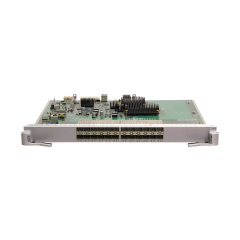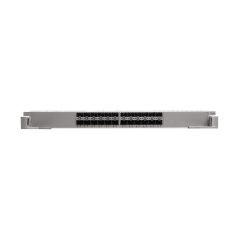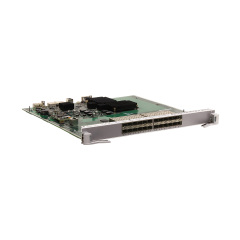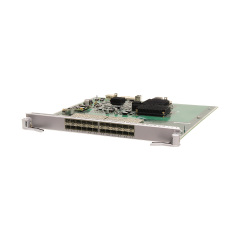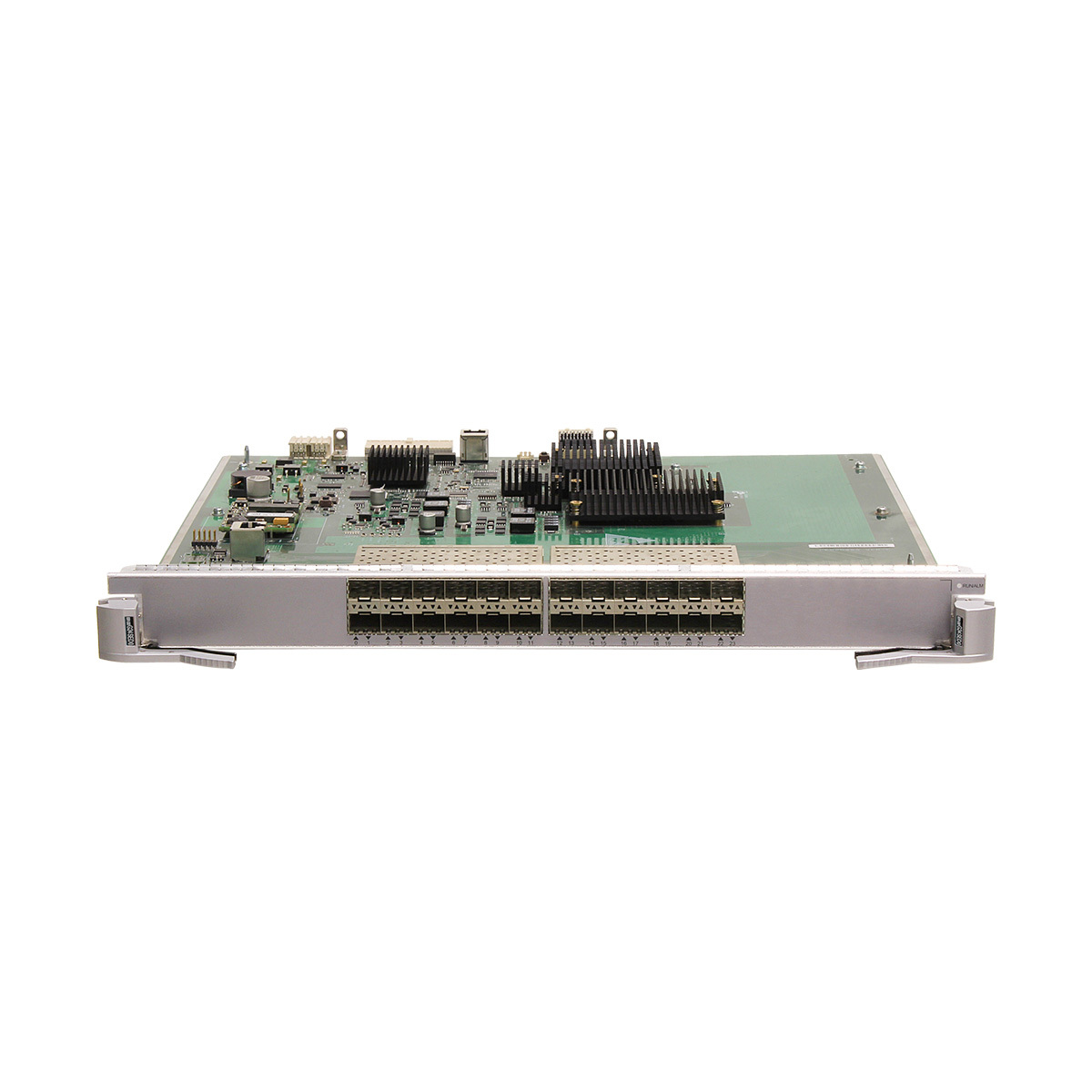
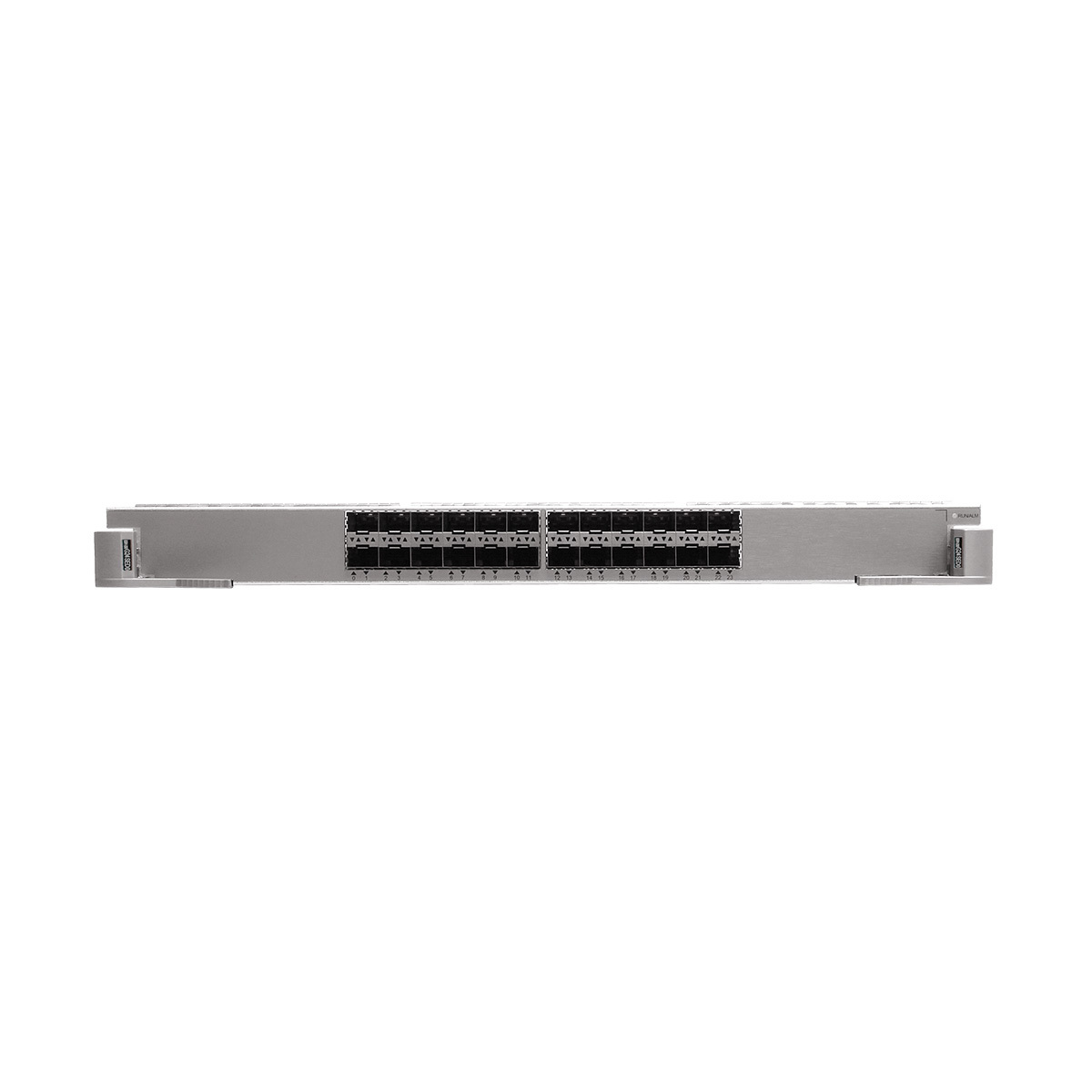
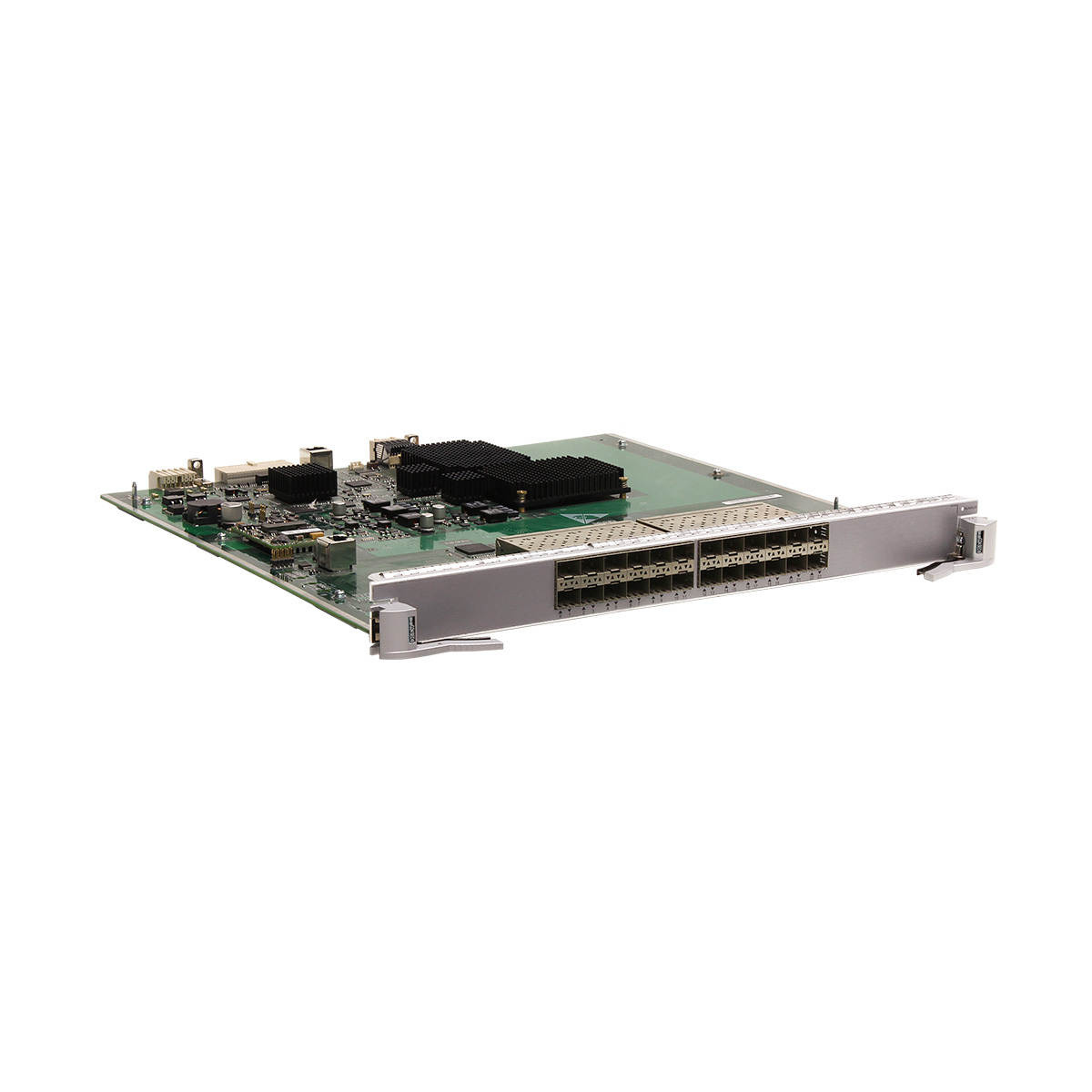
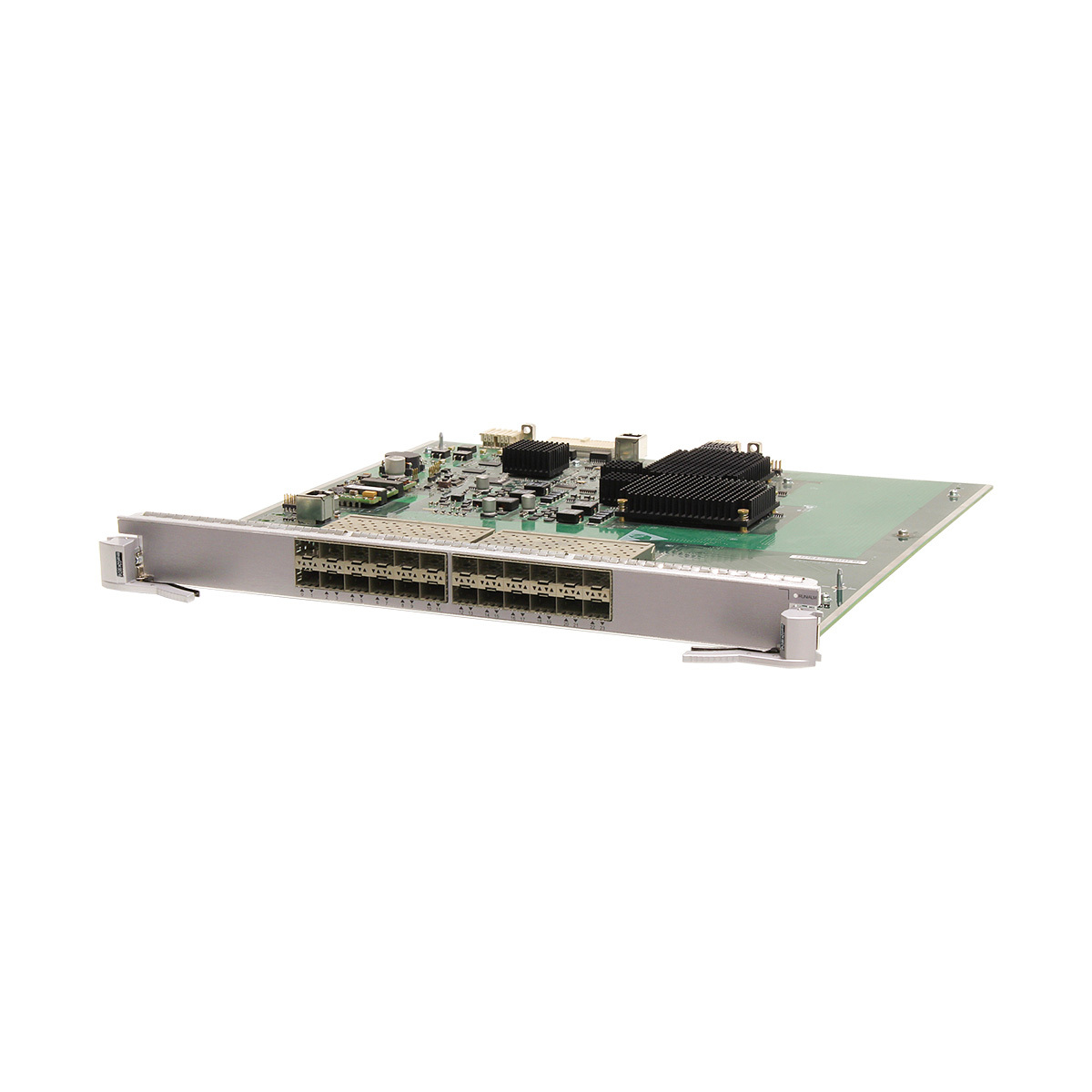
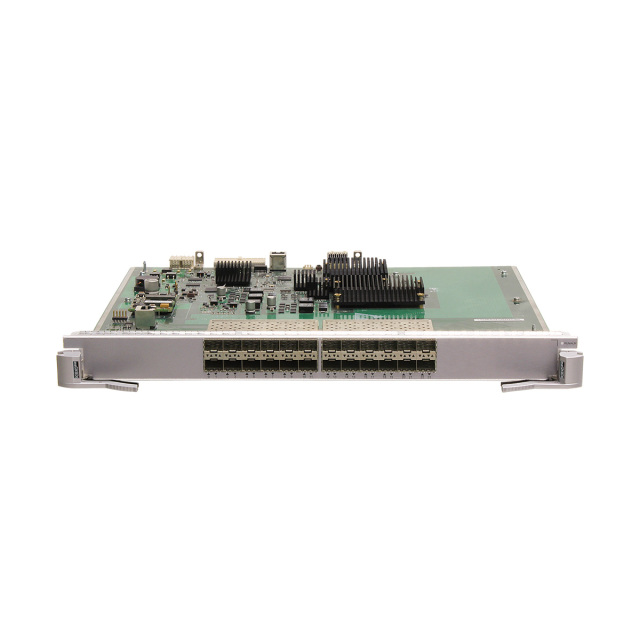
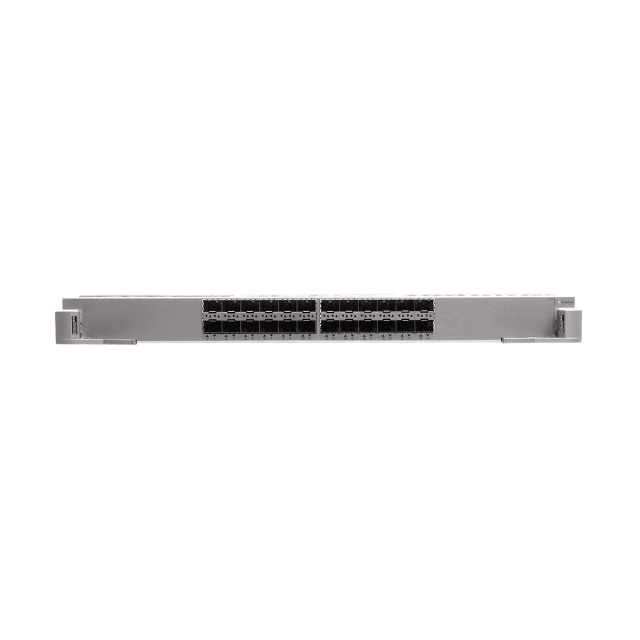
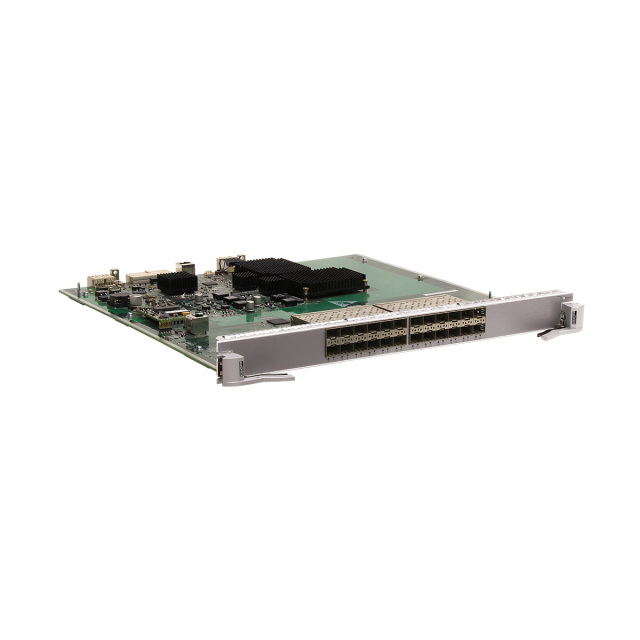
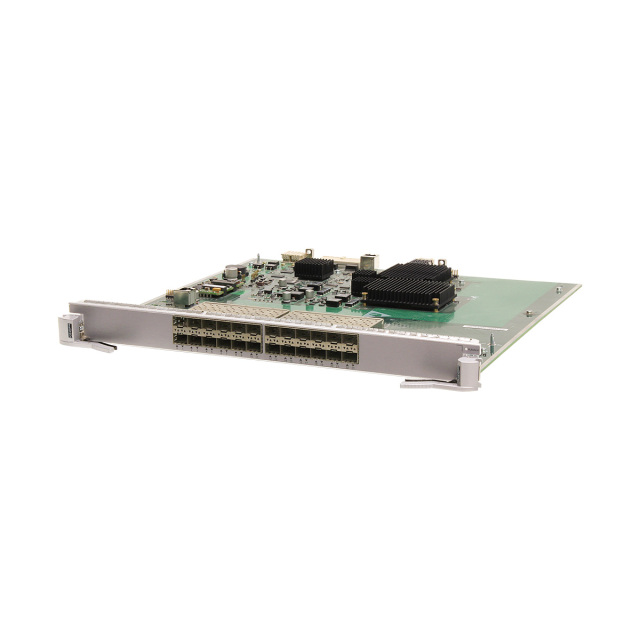
The ES1D2G24SED0 can be installed in:
The S7700 series switches (S7700 for short) are high-end smart routing switches designed for nextgenerationenterprise networks. The S7700 design is based on Huawei’s intelligent multi-layer switching technology to provide intelligent service optimization methods, such as MPLS VPN, traffic analysis, comprehensive H-QoS policies, controllable multicast, load balancing, and security, in addition to high-performanceLayer 2 to Layer 4 switching services.
Functional Role and Intended Users of Huawei ES1D2G24SED0 Interface Card
The Huawei ES1D2G24SED0 Interface Card is engineered as a high-density uplink expansion module for Huawei S7700 series switches, targeting enterprise network engineering teams and system integrators focused on next-generation network deployments. This card is compatible with multiple S7700 chassis models, including the S7700-S, S7706, and S7712, providing installation flexibility across different slot configurations. Its primary function is to facilitate uplink scalability by adding 24 100/1000BASE-X GE optical ports that enable robust data transmission. Network architects leveraging Huawei’s intelligent multi-layer switching technology utilize this interface card to implement comprehensive service optimization methods such as MPLS VPN, traffic analysis, and H-QoS policies within enterprise environments.
Technical Specifications and Measurable Features of the Huawei ES1D2G24SED0 Interface Card
The Huawei ES1D2G24SED0 Interface Card incorporates twenty-four SFP-based 100/1000BASE-X optical ports, offering compatibility with an extensive range of SFP modules for FE and GE applications. The card supports hot-swapping and distributed forwarding, minimizing downtime and ensuring reliable packet processing across Layer 2 to Layer 4. Designed for adherence to IEEE 802.3z and IEEE 802.3ab standards, it operates optimally within a temperature range of 0°C to 70°C. Slot compatibility spans 01 to 03 for S7700-S chassis, 01 to 06 for S7706 PoE models, and 01 to 12 for S7712, supporting varied deployment scales. This modular design enables scalable network capacity expansion, accommodating evolving bandwidth demands while maintaining engineering reliability and integration consistency.
Industry Applications and Operational Value of Huawei ES1D2G24SED0 Interface Card
In enterprise backbone and campus network infrastructures, the Huawei ES1D2G24SED0 Interface Card plays a critical role in enhancing uplink density and link resilience in Huawei S7700-based deployments. It enables network modernization efforts by introducing scalable 24-port uplinks without wholesale switch replacement, supporting aggregation layers and core network expansion. The interface card’s hot-swappable nature reduces maintenance windows for high-availability networks, promoting operational continuity. Its compatibility with multiple SFP optical modules facilitates customized deployment scenarios, including cross-city backbone transmission within distances up to 70km using single-mode fiber. Network engineers rely on these capabilities to optimize traffic load balancing, multicast control, and security policies inherent in Huawei’s advanced switching ecosystems.
Product Advantages
Structural and Design Benefits of Huawei ES1D2G24SED0 Interface Card
The Huawei ES1D2G24SED0 Interface Card exhibits a modular architecture specifically tailored for seamless integration into Huawei S7700-series chassis, supporting a wide range of slot configurations from S7700-S to S7712 platforms. This design approach ensures adaptability across diverse enterprise switch form factors, facilitating flexible infrastructure scaling. Hot-swappable functionality allows replacement or upgrade without network downtime, critical for maintaining continuous service in enterprise environments. The card’s utilization of standard SFP optical interfaces promotes interoperability with various optical modules, enabling network design customization. Distributed forwarding capability further enhances data handling efficiency by offloading traffic processing to the line card, reducing bottlenecks and optimizing switch fabric performance.
Performance and Operational Advantages of Huawei ES1D2G24SED0 Interface Card
Performance-wise, the Huawei ES1D2G24SED0 Interface Card delivers consistent 1G uplink speeds through 24 GE optical ports supporting 100/1000BASE-X standards, ensuring transmission stability and network throughput. Its hot-swappable characteristic minimizes service interruptions during maintenance or upgrades, aligning with high-availability requirements. The broad compatibility with SFP modules accommodates a variety of fiber types and distances, including long-distance single-mode links up to 70km, enabling scalable and cost-effective network extension. From a usability perspective, this interface card streamlines complex network topology expansions while maintaining compliance with IEEE standards and Huawei’s intelligent multi-layer switching protocols, facilitating efficient network management and operational reliability.
Functions of the ES1D2G24SED0
|
Function |
Description |
|---|---|
|
Basic function |
Provides twenty-four GE optical ports for data transmission and switching. |
|
Distributed forwarding |
Performs concurrent data forwarding using a distributed data plane. |
|
Hot swapping |
The ES1D2G24SED0 is hot swappable. |
|
Attribute |
Description |
|---|---|
|
Connector type |
SFP |
|
Optical port attributes |
Depend on the SFP optical module used. For details about optical modules supported by the ES1D2G24SED0 and their attributes, see FE SFP/eSFP Optical Modules, GE eSFP Optical Modules, GE-CWDM eSFP Optical Modules, and GE-DWDM eSFP Optical Modules. |
|
Standards compliance |
IEEE 802.3z |
|
Frame format |
Ethernet_II, Ethernet_SAP, Ethernet_SNAP |
|
Network protocol |
IP |
100/1000BASE-X optical port with a copper module installed.
|
Attribute |
Description |
|---|---|
|
Connector type |
SFP |
|
Optical port attributes |
Depend on the SFP copper module used. For details on the copper modules supported by the cards and attributes of the copper modules, see GE SFP Copper Modules (10 Mbit/s, 100 Mbit/s and 1000 Mbit/s rates). |
|
Standards compliance |
IEEE 802.3ab |
|
Frame format |
Ethernet_II, Ethernet_SAP, Ethernet_SNAP |
|
Network protocol |
IP |
| Item | ES1D2G24SED0 | ||
| Apply to S7700 Switch | |||
| Optical port attributes | |||
| Connector type | SFP | ||
| Optical port attributes | Depend on the SFP optical module used | ||
| Standards compliance | IEEE 802.3z | ||
| Frame format | Ethernet_II, Ethernet_SAP, Ethernet_SNAP | ||
| Network protocol | IP | ||
| Attributes of FE optical modules | |||
| Operating Temperature | 0°C to 70°C (32°F to 158°F) | ||
| Model | Transmission Distance (km) | Standard | Fiber Type |
| SFP-FE-SX-MM1310 (SFP optical module) | ≤ 2 | 100base-FX | Fiber mode: multimode Core diameter: 50 μm or 62.5 μm Connector type: LC |
| eSFP-FE-LX-SM1310 | ≤ 15 | 100base-LX | Fiber mode: single-mode Connector type: LC |
| S-SFP-FE-LH40-SM1310 | ≤ 40 | ||
| S-SFP-FE-LH80-SM1550 | ≤ 80 | ||
| SFP-FE-LX-SM1310-BIDI (Single-fiber bidirectional) | ≤ 15 | 100base-BX | |
| SFP-FE-LX-SM1550-BIDI (Single-fiber bidirectional) | |||
| Attributes of GE optical modules | |||
| eSFP-GE-SX-MM850 | ≤ 0.22 | 1000base-SX | Fiber mode: multimode Modal Bandwidth: 160 MHz*km Core diameter: 62.5 μm Connector type: LC |
| ≤ 0.275 | Fiber mode: multimode (OM1) Connector type: LC | ||
| ≤ 0.5 | Fiber mode: multimode Modal Bandwidth: 400 MHz*km Core diameter: 50 μm Connector type: LC | ||
| ≤ 0.55 | Fiber mode: multimode (OM2) Connector type: LC | ||
| ≤ 1 | Fiber mode: multimode (OM3) Connector type: LC | ||
| SFP-GE-LX-SM1310 | ≤ 10 | 1000base-LX/LH | Fiber mode: single-mode Connector type: LC |
| S-SFP-GE-LH40-SM1310 | ≤ 40 | ||
| S-SFP-GE-LH40-SM1550 | |||
| S-SFP-GE-LH80-SM1550 | ≤ 80 | 1000base-ZX | |
| eSFP-GE-ZX100-SM1550 | ≤ 100 | ||
| SFP-GE-LX-SM1310-BIDI (Single-fiber bidirectional) | ≤ 10 | 1000base-BX | |
| SFP-GE-LX-SM1490-BIDI (Single-fiber bidirectional) | |||
| LE2MGSC40DE0 (Single-fiber bidirectional) | ≤ 40 | ||
| LE2MGSC40ED0 (Single-fiber bidirectional) | |||
| SFP-GE-ZBXD1 (Single-fiber bidirectional)can only be used on switch running V200R008C00 or later version. | ≤ 80 | 1000base-BX | |
| SFP-GE-ZBXU1 (Single-fiber bidirectional)can only be used on switch running V200R008C00 or later version. | |||
| SFP-GE-BXU1-SC (Single-fiber bidirectional) | ≤ 10 | 1000base-BX | Fiber mode: single-mode Connector type: SC |
| Attributes of eSFP CWDM optical modules | |||
| Center Wavelength (nm), Model | |||
| 1471, CWDM-SFPGE-1471 | 1491, CWDM-SFPGE-1491 | 1511, CWDM-SFPGE-1511 | 1531, CWDM-SFPGE-1531 |
| 1551, CWDM-SFPGE-1551 | 1571, CWDM-SFPGE-1571 | 1591, CWDM-SFPGE-1591 | 1611, CWDM-SFPGE-1611 |
| Specifications | Encapsulation type: eSFP | ||
| Transmission distance: ≤ 80 km | |||
| Fiber type: single-mode, LC | |||
| Standard: CWDM | |||
| Operating temperature: 0°C to 70°C (32°F to 158°F) | |||
| Transmit power: 0 dBm to 5.0 dBm Receiver sensitivity: ≤ -28.0 dBm Overload optical power: -9.0 dBm Extinction ratio: ≥ 8.5 dB | |||
| Attributes of eSFP DWDM optical modules | |||
| Center Wavelength (nm), Model | |||
| 1529.55, DWDM-SFPGE-1529-55 | 1530.33, DWDM-SFPGE-1530-33 | 1531.12, DWDM-SFPGE-1531-12 | 1531.90, DWDM-SFPGE-1531-90 |
| 1532.68, DWDM-SFPGE-1532-68 | 1533.47, DWDM-SFPGE-1533-47 | 1534.25, DWDM-SFPGE-1534-25 | 1535.04, DWDM-SFPGE-1535-04 |
| 1535.82, DWDM-SFPGE-1535-82 | 1536.61, DWDM-SFPGE-1536-61 | 1537.40, DWDM-SFPGE-1537-40 | 1538.19, DWDM-SFPGE-1538-19 |
| 1538.98, DWDM-SFPGE-1538-98 | 1539.77, DWDM-SFPGE-1539-77 | 1540.56, DWDM-SFPGE-1540-56 | 1541.35, DWDM-SFPGE-1541-35 |
| 1542.14, DWDM-SFPGE-1542-14 | 1542.94, DWDM-SFPGE-1542-94 | 1543.73, DWDM-SFPGE-1543-73 | 1544.53, DWDM-SFPGE-1544-53 |
| 1545.32, DWDM-SFPGE-1545-32 | 1546.12, DWDM-SFPGE-1546-12 | 1546.92, DWDM-SFPGE-1546-92 | 1547.72, DWDM-SFPGE-1547-72 |
| 1548.51, DWDM-SFPGE-1548-51 | 1549.32, DWDM-SFPGE-1549-32 | 1550.12, DWDM-SFPGE-1550-12 | 1550.92, DWDM-SFPGE-1550-92 |
| 1551.72, DWDM-SFPGE-1551-72 | 1552.52, DWDM-SFPGE-1552-52 | 1553.33, DWDM-SFPGE-1553-33 | 1554.13, DWDM-SFPGE-1554-13 |
| 1554.94, DWDM-SFPGE-1554-94 | 1555.75, DWDM-SFPGE-1555-75 | 1556.55, DWDM-SFPGE-1556-55 | 1557.36, DWDM-SFPGE-1557-36 |
| 1558.17, DWDM-SFPGE-1558-17 | 1558.98, DWDM-SFPGE-1558-98 | 1559.79, DWDM-SFPGE-1559-79 | 1560.61, DWDM-SFPGE-1560-61 |
| Specifications | Encapsulation type: eSFP | ||
| Transmission distance: ≤ 120 km | |||
| Fiber type: single-mode, LC | |||
| Standard: DWDM | |||
| Operating temperature: 0°C to 45°C (32°F to 113°F) | |||
| Transmit power: 0 dBm to 4.0 dBm Receiver sensitivity: ≤ -28.0 dBm Overload optical power: -8.0 dBm Extinction ratio: ≥ 8.2 dB | |||
| Physical specifications | |||
| Dimensions(W x D x H): | 394.7 mm x 426.8 mm x 35.1 mm (15.5 in. x 16.8 in. x 1.4 in.) | ||
| Weight: | 2.66 kg (5.86 lb) | ||
| Maximum power consumption: | 75 W | ||
| Environment parameters | |||
| Operating temperature | 0°C to 45°C (32°F to 113°F) | ||
| Operating relative humidity | 5% RH to 95% RH (noncondensing) | ||
| Storage temperature | -40°C to +70°C (-40°F to +158°F) | ||
| Storage relative humidity | 5% RH to 95% RH (noncondensing) | ||
Use Scenarios
Enterprise Backbone Network Uplink Expansion
In large-scale enterprise backbone networks, the Huawei ES1D2G24SED0 Interface Card serves to augment existing Huawei S7700 switch infrastructures by providing a compact 24-port 1G uplink interface. It enables data center and core network engineers to expand uplink capacity without replacing legacy switches, optimizing capital expenditure. The card's broad SFP compatibility supports various optical fiber modules suitable for diverse link distances and fiber types, including long-reach single-mode deployments. This facilitates backbone load balancing, MPLS VPN implementations, and multicast traffic control within complex enterprise environments. By integrating into Huawei’s aggregated network architecture, this card enhances backbone resiliency and throughput in alignment with enterprise-grade QoS and security policy enforcement.
Campus Network Aggregation and Layer 2/3 Switching Enhancement
Within campus network environments, the Huawei ES1D2G24SED0 Interface Card is deployed primarily to increase uplink port density at aggregation layers connecting access switches to core Huawei S7700 switches. Network engineers utilize this interface card to consolidate multiple 1G uplinks, improving traffic aggregation efficiency and simplifying network topology. Its hot-swappable capability ensures minimal disruption during equipment maintenance in operational campuses demanding constant connectivity. The card’s compliance with industry-standard protocols supports seamless integration into existing Layer 2 and Layer 3 switching frameworks, supporting load balancing, traffic analysis, and security policy enforcement tailored for enterprise and educational campuses with evolving bandwidth requirements.
ES1D2G24SED0 FAQ
Q1: Is it compatible with Huawei S9708 switches? Will there be bandwidth bottlenecks or signal attenuation when 24 ports are simultaneously operating at full load for long-distance 10 Gigabit transmission?
A1: Fully compatible! Supports the entire S9300/S9700 series, with backplane bandwidth ≥240Gbps. With SFP + long-distance modules, signal attenuation is <0.8dB within 80km, ensuring no bottlenecks during full-load transmission and meeting high-end long-distance requirements.
Q2: How stable is the 70km transmission when deployed with single-mode fiber in a cross-city backbone network? What are its advantages compared to ordinary 10 Gigabit long-distance models?
A2: No packet loss or latency fluctuations within 70km, supporting repeater-free transmission; ordinary 10 Gigabit models only support ≤40km. This product increases the transmission distance by 100%, eliminating the need for additional repeater equipment and reducing deployment and maintenance costs.
Q3: How to choose between 16/32-port / ordinary 10 Gigabit high-end / mid-range 10 Gigabit line boards?
A3: 16 ports are suitable for <15 10 Gigabit devices, 32 ports are redundant. The standard high-end model only supports ≤40km, and the mid-range model has insufficient long-distance performance. For 15-30 10 Gigabit devices + 40km-80km transmission + high-end reliability requirements, this product is the best choice.
| Module Name | Maximum Transmission Distance |
| FE SFP/eSFP Optical Modules | |
| SFP-FE-SX-MM1310 | 2 km |
| eSFP-FE-LX-SM1310 | 15 km |
| S-SFP-FE-LH40-SM1310 | 40 km |
| S-SFP-FE-LH80-SM1550 | 80 km |
| SFP-FE-LX-SM1310-BIDI (Single-Fiber-Bidirectional Module) | 15 km |
| SFP-FE-LX-SM1550-BIDI (Single-Fiber-Bidirectional Module) | 15 km |
| GE eSFP Optical Modules | |
| eSFP-GE-SX-MM850 |
|
| SFP-GE-LX-SM1310 | 10 km |
| S-SFP-GE-LH40-SM1310 | 40 km |
| S-SFP-GE-LH40-SM1550 | 40 km |
| S-SFP-GE-LH80-SM1550 | 80 km |
| eSFP-GE-ZX100-SM1550 | 100 km |
| SFP-GE-LX-SM1310-BIDI (Single-Fiber-Bidirectional Module) | 10 km |
| SFP-GE-LX-SM1490-BIDI (Single-Fiber-Bidirectional Module) | 10 km |
| LE2MGSC40DE0 (Single-Fiber-Bidirectional Module) | 40 km |
| LE2MGSC40ED0 (Single-Fiber-Bidirectional Module) | 40 km |
| SFP-GE-ZBXD1 (Single-Fiber-Bidirectional Module) | 80 km |
| SFP-GE-ZBXU1 (Single-Fiber-Bidirectional Module) | 80 km |
| SFP-GE-BXU1-SC (Single-Fiber-Bidirectional Module) | 10 km |
| GE CSFP Optical Modules | |
| CSFP-GE-FE-BXD1 | 10 km |
| CSFP-GE-FE-BIDI2 | 20 km |
| CSFP-GE-FE-BIDI4 | 40 km |
| GE-CWDM eSFP Optical Modules | |
| CWDM-SFPGE-1471 | 80 km |
| CWDM-SFPGE-1491 | 80 km |
| CWDM-SFPGE-1511 | 80 km |
| CWDM-SFPGE-1531 | 80 km |
| CWDM-SFPGE-1551 | 80 km |
| CWDM-SFPGE-1571 | 80 km |
| CWDM-SFPGE-1591 | 80 km |
| CWDM-SFPGE-1611 | 80 km |
| GE-CWDM eSFP Optical Modules | |
| CWDM-SFPGE-1271 | 80 km |
| CWDM-SFPGE-1291 | 80 km |
| CWDM-SFPGE-1311 | 80 km |
| CWDM-SFPGE-1331 | 80 km |
| CWDM-SFPGE-1351 | 80 km |
| CWDM-SFPGE-1371 | 80 km |
| CWDM-SFPGE-1391 | 80 km |
| CWDM-SFPGE-1411 | 80 km |
| CWDM-SFPGE-1431 | 80 km |
| CWDM-SFPGE-1451 | 80 km |
| CWDM-SFPGE-1471 | 80 km |
| CWDM-SFPGE-1491 | 80 km |
| CWDM-SFPGE-1511 | 80 km |
| CWDM-SFPGE-1531 | 80 km |
| CWDM-SFPGE-1551 | 80 km |
| CWDM-SFPGE-1571 | 80 km |
| CWDM-SFPGE-1591 | 80 km |
| CWDM-SFPGE-1611 | 80 km |
| GE-DWDM eSFP Optical Modules | |
| DWDM-SFPGE-1560-61 | 120 km |
| 10GE SFP+ Optical Modules | |
| SFP-10G-USR | 0.1 km |
| OSXD22N00 |
|
| OMXD30000 |
|
| SFP-10G-iLR | 1.4 km |
| OSX010000 | 10 km |
| OSX040N01 | 40 km |
| SFP-10G-ER-1310 | 40 km |
| SFP-10G-ZR | 80 km |
| SFP-10G-BXU1 (Single-Fiber-Bidirectional Module) | 10 km |
| SFP-10G-BXD1 (Single-Fiber-Bidirectional Module) | 10 km |
| SFP-10G-ER-SM1330-BIDI (Single-Fiber-Bidirectional Module) | 40 km |
| SFP-10G-ER-SM1270-BIDI (Single-Fiber-Bidirectional Module) | 40 km |
| 10GE XFP Optical Modules | |
| XFP-SX-MM850 |
|
| XFP-STM64-LX-SM1310 | 10 km |
| XFP-STM64-LH40-SM1550 | 40 km |
| XFP-STM64-SM1550-80km | 80 km |
| 10GE-CWDM SFP+ Optical Modules | |
| SFP-10G-ZCW1471 | 70 km |
| SFP-10G-ZCW1491 | 70 km |
| SFP-10G-ZCW1511 | 70 km |
| SFP-10G-ZCW1531 | 70 km |
| SFP-10G-ZCW1551 | 70 km |
| SFP-10G-ZCW1571 | 70 km |
| SFP-10G-ZCW1591 | 70 km |
| SFP-10G-ZCW1611 | 70 km |
| 10GE-CWDM XFP Optical Modules | |
| CWDM-XFP10G-1471 | 70 km |
| CWDM-XFP10G-1491 | 70 km |
| CWDM-XFP10G-1511 | 70 km |
| CWDM-XFP10G-1531 | 70 km |
| CWDM-XFP10G-1551 | 70 km |
| CWDM-XFP10G-1571 | 70 km |
| CWDM-XFP10G-1591 | 70 km |
| CWDM-XFP10G-1611 | 70 km |
| 10GE-DWDM SFP+ Optical Modules | |
| SFP-10G-ZDWT | 60 km |
| 10GE-DWDM XFP Optical Modules | |
| DWDM-XFP10G-1533-47 | 80 km |
| DWDM-XFP10G-1534-25 | 80 km |
| DWDM-XFP10G-1535-04 | 80 km |
| DWDM-XFP10G-1552-52 | 80 km |
| DWDM-XFP10G-1553-33 | 80 km |
| DWDM-XFP10G-1554-13 | 80 km |
| DWDM-XFP10G-1530-33 | 80 km |
| DWDM-XFP10G-1549-32 | 80 km |
| DWDM-XFP10G-1531-12 | 80 km |
| DWDM-XFP10G-1531-90 | 80 km |
| DWDM-XFP10G-1550-12 | 80 km |
| DWDM-XFP10G-1550-92 | 80 km |
| DWDM-XFP10G-1532-68 | 80 km |
| DWDM-XFP10G-1551-72 | 80 km |
| DWDM-XFP10G-1529-55 | 80 km |
| DWDM-XFP10G-1548-51 | 80 km |
| 40GE QSFP+ Optical Modules | |
| QSFP-40G-SR4 |
|
| QSFP-40G-iSR4 |
|
| QSFP-40G-eSR4 |
|
| QSFP-40G-iSM4 | 1.4 km |
| QSFP-40G-eSM4 | 10 km |
| QSFP-40G-LX4 |
Single-mode fiber: 2 km Multimode fiber (OM3): 0.15 km |
| QSFP-40G-LR4 | 10 km |
| QSFP-40G-ER4 | 40 km |
| QSFP-40G-SR-BD |
|
| QSFP-40G-SDLC-PAM |
|
| QSFP-40G-eSDLC-PAM |
|
| 40GE CFP Optical Modules | |
| CFP-40G-SR4 |
|
| CFP-40G-LR4 | 10 km |
| CFP-40G-ER4 | 40 km |
| CFP-40G-ZR4 | 80 km |
| 100GE CFP Optical Modules | |
| CFP-100G-SR10 |
|
| CFP-100G-LR4 | 10 km |
| CFP-100G-ER4 | 40 km |
| 100GE QSFP28 Optical Modules | |
| QSFP28-100G-LR4 | 10 km |
| QSFP28-100G-10KM | 10 km |
| QSFP28-100G-PSM4 | 500 m |
| QSFP28-100G-SR4 |
|
| QSFP-100G-eSR4 |
|
| QSFP-100G-CLR4 | 2 km |
| QSFP-100G-CWDM4 | 2 km |
| QSFP-100G-ER4-Lite | Single-mode fiber (G.652):
|
| GPON Optical Modules | |
| H87MMA5671A2 | 20 km |
| Industrial Optical Modules | |
| OGSM01880 |
|
| OGSC10DD0 | 10 km |
| OGSC40DD0 | 40 km |
| SFP+10GE-LH10-SM1310 | 10 km |
| SFP-10G-SR | 0.3 km |
| SFP-10G-iLR | 1.4 km |
| SFP-10G-BXU1 (Single-Fiber-Bidirectional Module) | 10 km |
| SFP-10G-BXD1 (Single-Fiber-Bidirectional Module) | 10 km |
| SFP-GE-BX-D1-I (Single-Fiber-Bidirectional Module) | 10 km |
| SFP-GE-BX-U1-I (Single-Fiber-Bidirectional Module) | 10 km |