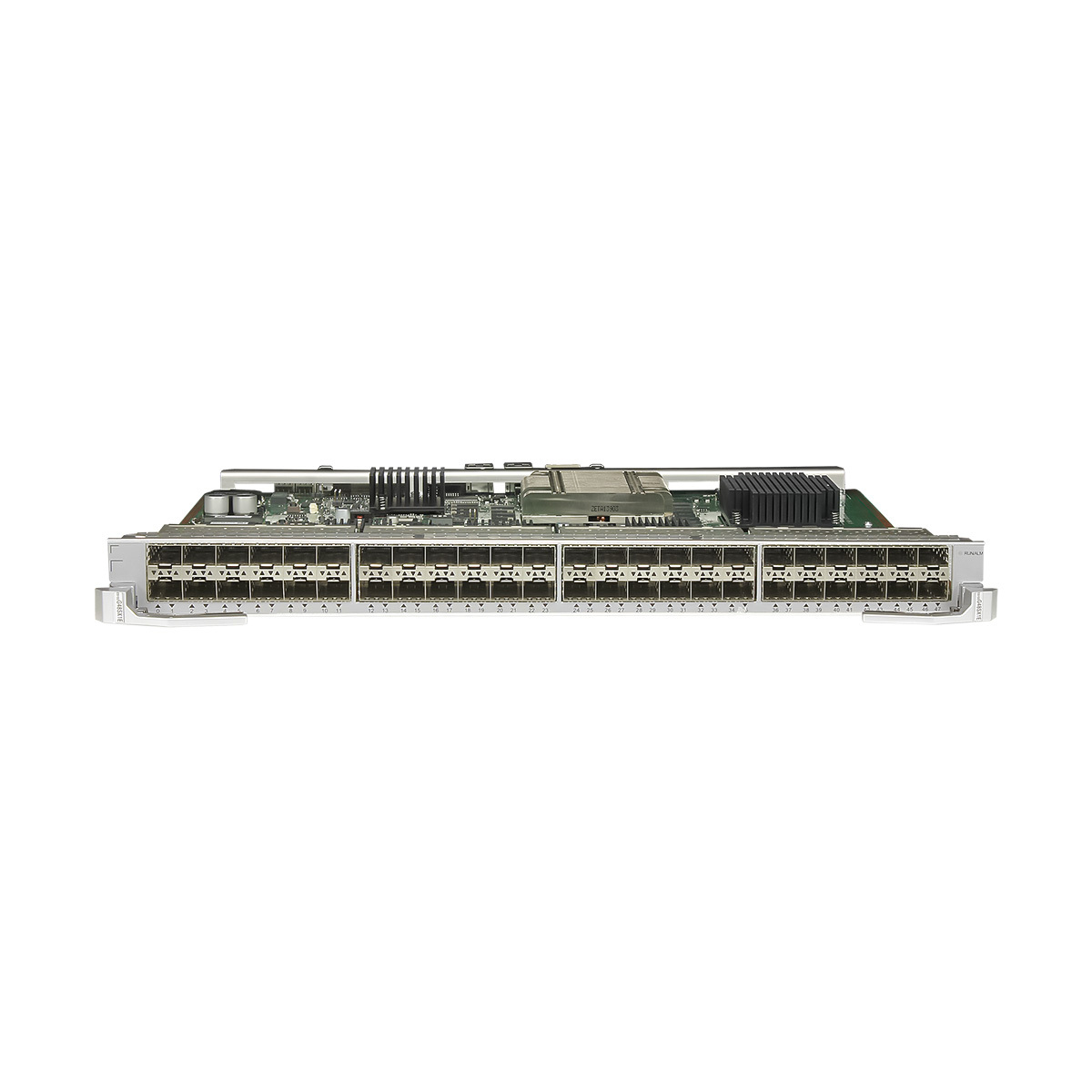
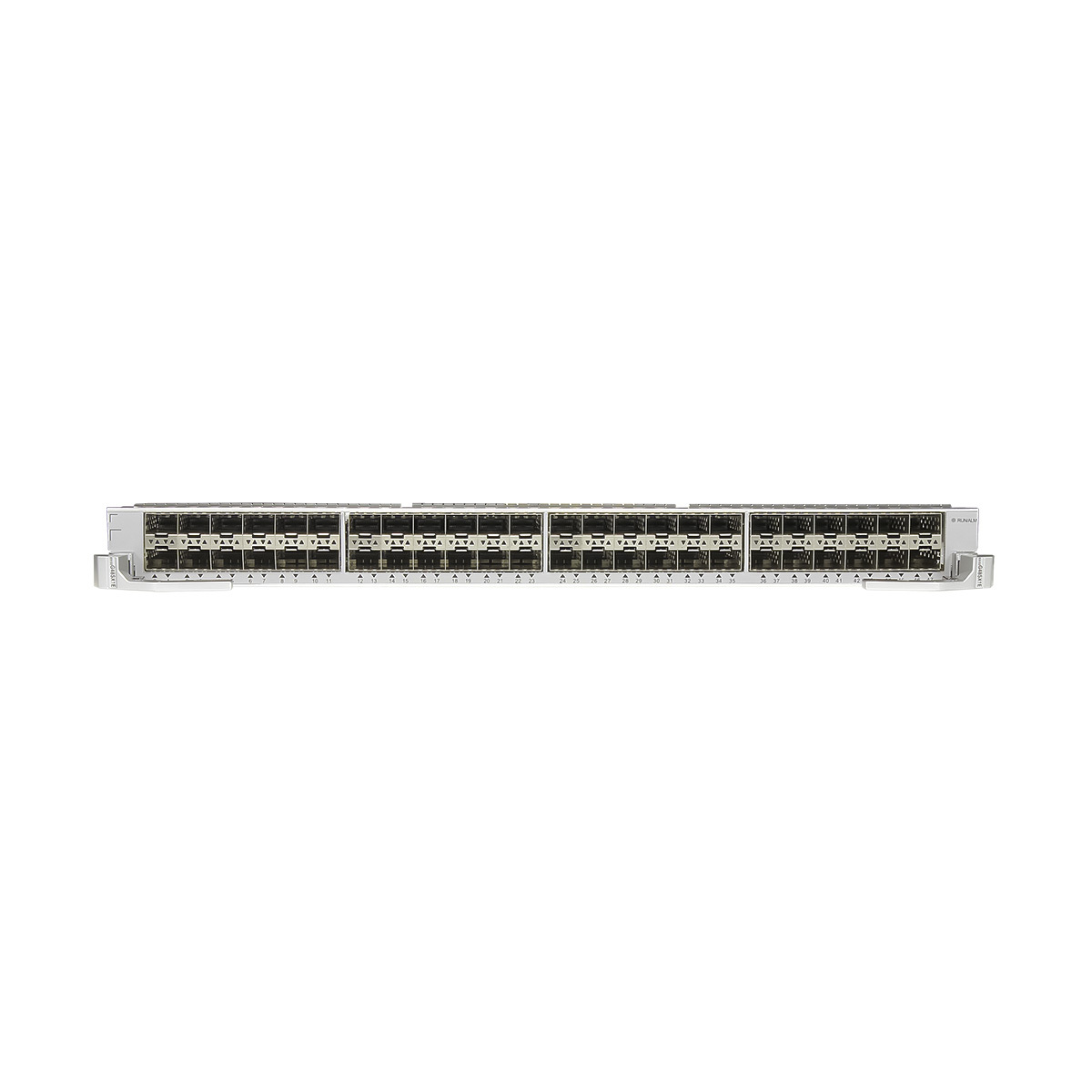
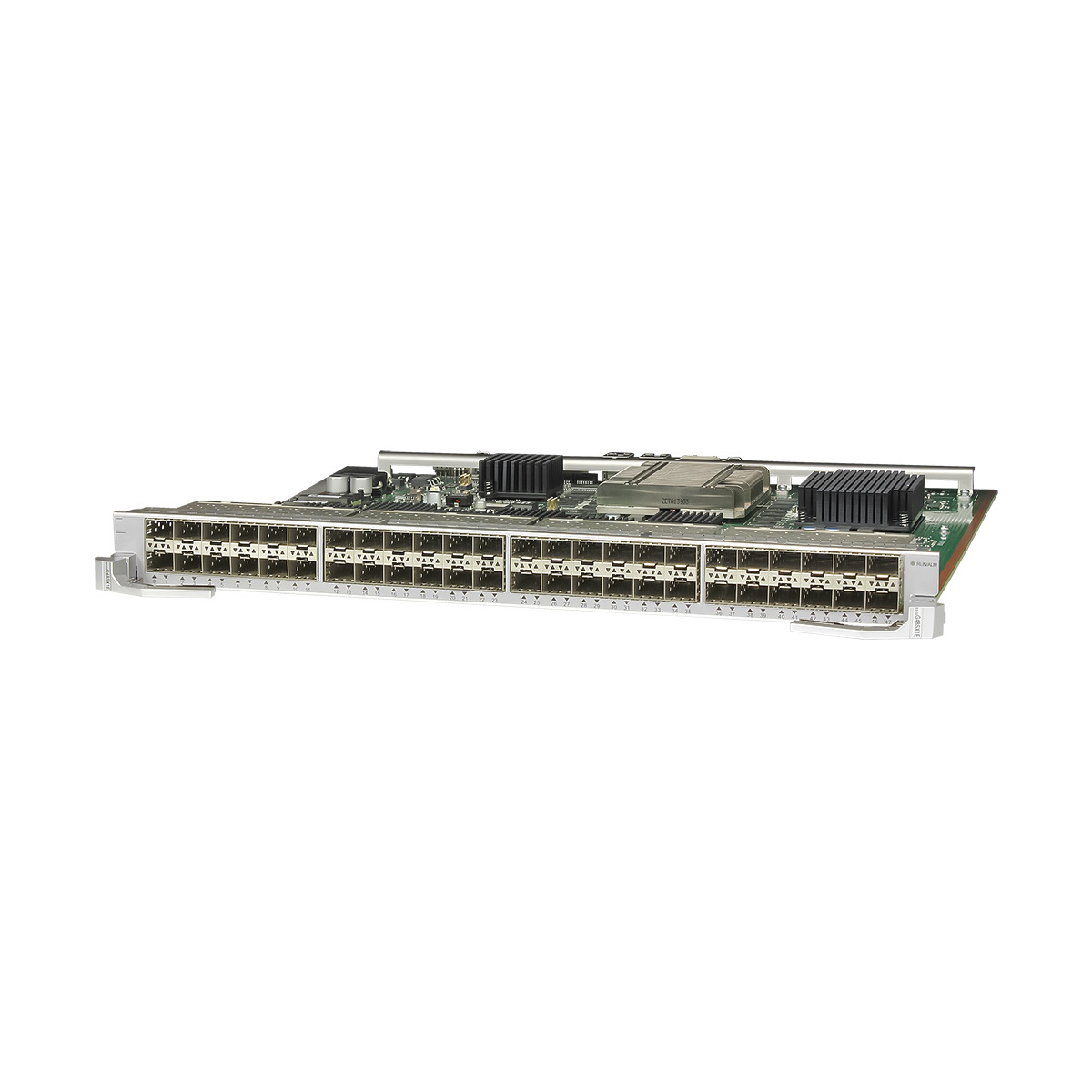
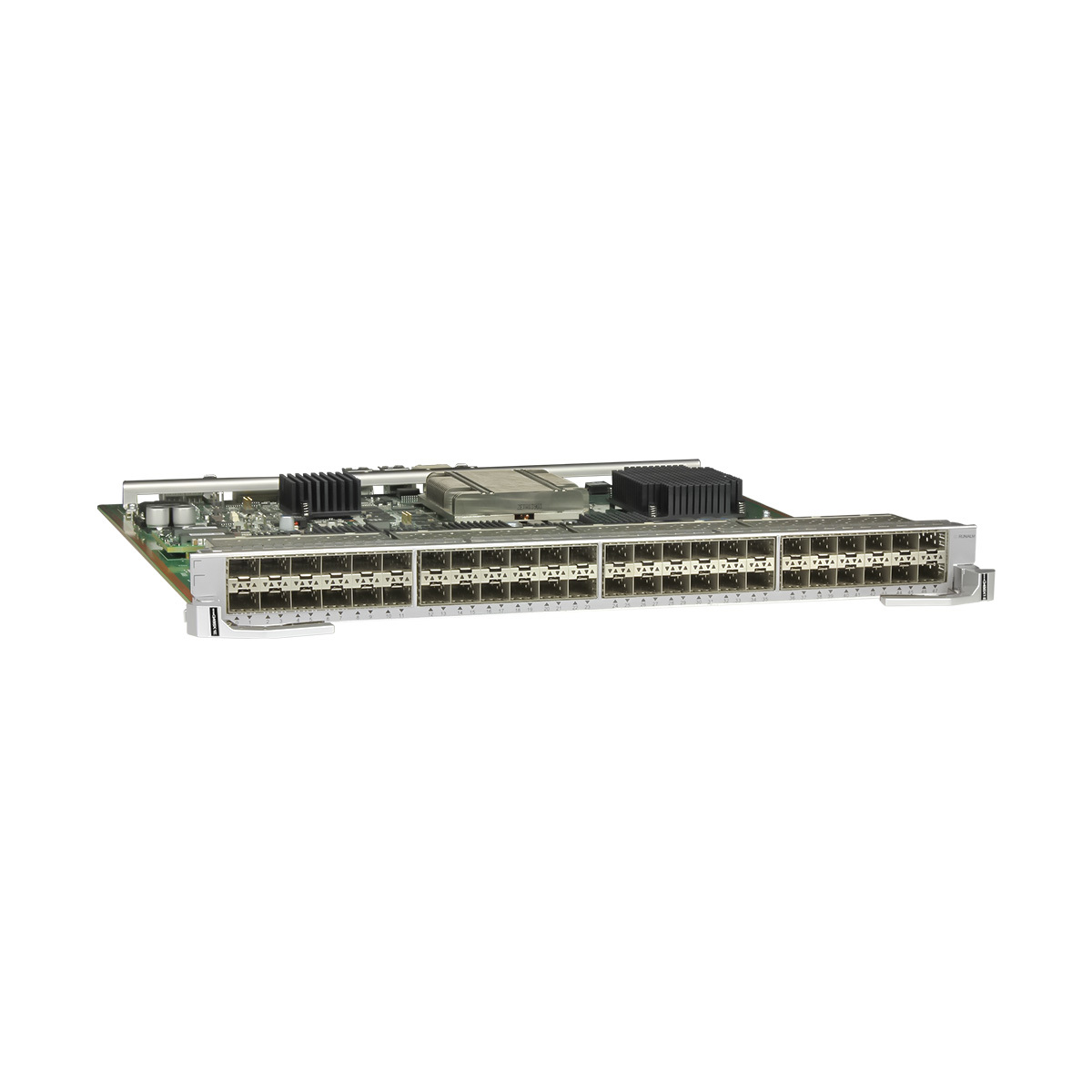
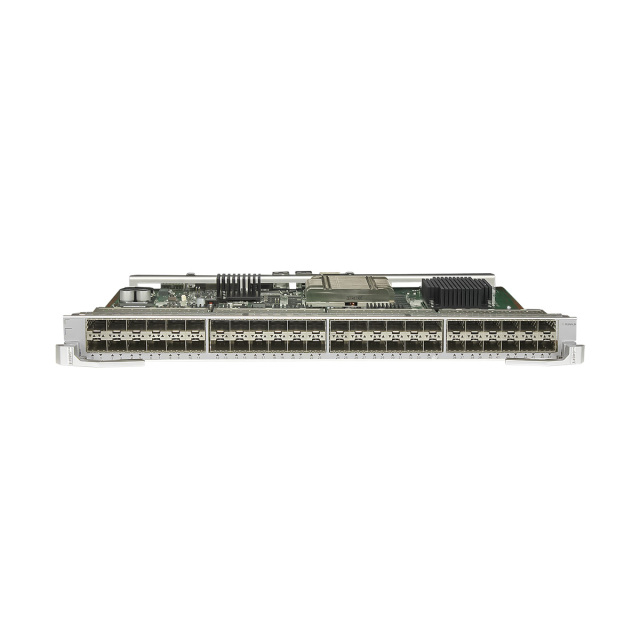
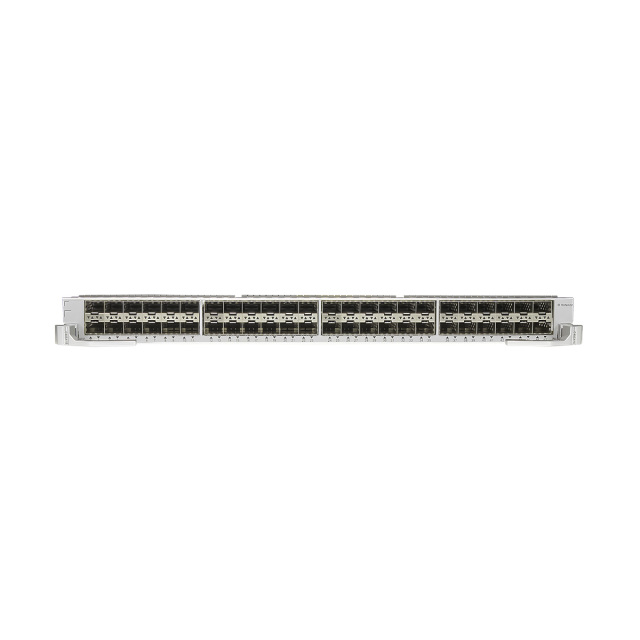
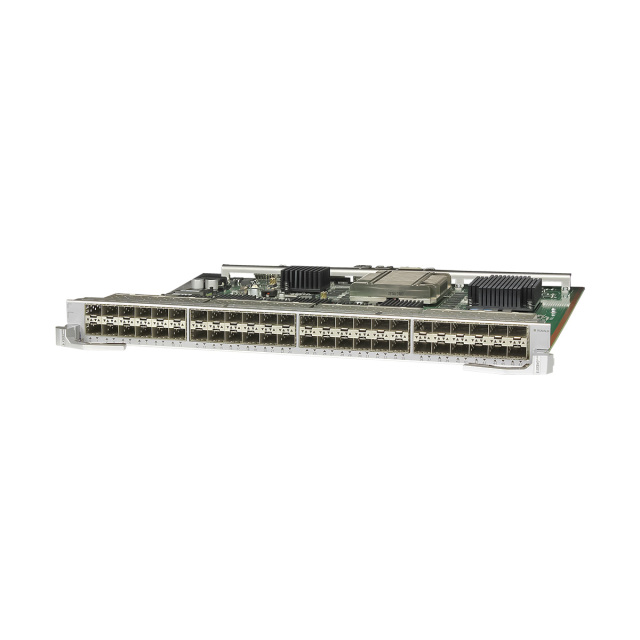
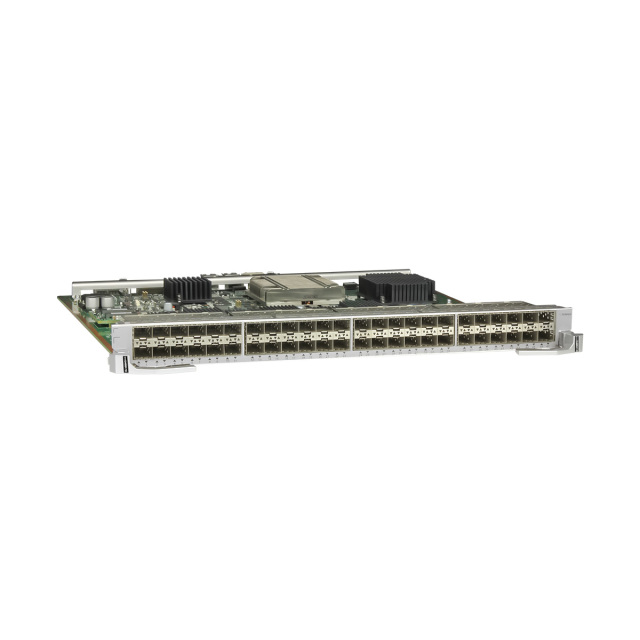
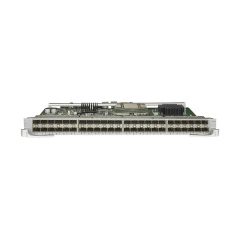
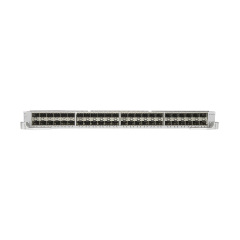
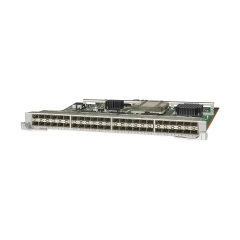
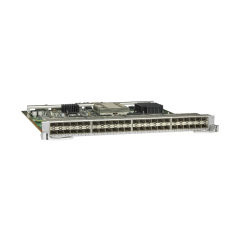
The S7700 series switches (S7700 for short) are high-end smart routing switches designed for nextgenerationenterprise networks. The S7700 design is based on Huawei’s intelligent multi-layer switching technology to provide intelligent service optimization methods, such as MPLS VPN, traffic analysis, comprehensive H-QoS policies, controllable multicast, load balancing, and security, in addition to high-performanceLayer 2 to Layer 4 switching services.
Functions of the ES1D2G48SX1E
The ES1D2G48SX1E provides the following functions:
Communicates with the MPU and works under the control of the MPU.
Searches for routes and destination addresses of data packets for forwarding.
Forwards data packets.
Functional Enhancement for Enterprise Network Expansion The Huawei ES1D2G48SX1E Interface Card is specifically engineered to expand port density within Huawei S7700 switch deployments, targeting network engineers and infrastructure managers managing enterprise core and distribution layers. By integrating 48 gigabit Ethernet ports compatible with 10/100/1000BASE-X standards, this interface card facilitates scalable network growth and bandwidth optimization. Its design supports rapid deployment and straightforward upgrade paths, addressing the requirements of large-scale, high-throughput environments that demand both copper and fiber connectivity options with SFP compatibility, thereby meeting diverse operational needs.
Technical Architecture and Specifications for Optimal Throughput Incorporating a modular 48-port GE optical interface with SFP connectors, the Huawei ES1D2G48SX1E Interface Card leverages advanced MPU-driven control plane technology to enable efficient packet routing and forwarding. It conforms to IEEE 802.3ab standards and supports Ethernet II, SAP, and SNAP frame formats, ensuring interoperability across multiple protocols. The hot-swappable design permits seamless maintenance and minimal network interruption. Operating within a temperature range of 0°C to 70°C, the module integrates tightly with Huawei S7700 chassis slot configurations, providing reliable performance and low insertion loss in fiber links up to 80 km, suitable for demanding enterprise network topologies.
Industry Deployment and Operational Impact Designed for deployment in enterprise network core and distribution switches, the Huawei ES1D2G48SX1E Interface Card enhances aggregation layer capacity while facilitating optimized traffic segmentation and segregation. Its compatibility with Huawei’s scalable switch architecture enables integration into existing infrastructures, supporting large campus, data center, and metro Ethernet environments requiring robust, high-throughput access. The interface card’s capability to maintain stable, continuous connection under heavy load conditions enables network administrators to meet stringent QoS and SLA requirements, ultimately driving improved network efficiency and reduced total cost of ownership in complex business-grade communication systems.
Product Advantages
Modular Design and System Integration Benefits The Huawei ES1D2G48SX1E Interface Card features a modular structural design optimized for insertion into Huawei S7700 switch slots, allowing scalable network design and simplified hardware management. Its compatibility with both copper and fiber transceivers via SFP modules provides flexibility for diverse deployment scenarios. The hot-swappable capability supports non-disruptive hardware replacement or upgrades, reducing operational downtime. Integration with the MPU control architecture ensures precise forwarding decisions and system stability across all 48 ports, contributing to streamlined installation and hardware lifecycle management within complex enterprise setups.
Enhanced Network Performance and Operational Value From a performance perspective, the Huawei ES1D2G48SX1E Interface Card delivers reliable gigabit speeds with low latency and high throughput across all ports, critical for load-intensive applications. Its seamless compatibility with Huawei’s advanced switching platform ensures efficient data forwarding and supports scalable network segmentation. The user-centric design simplifies maintenance tasks while maximizing uptime, directly contributing to higher ROI for enterprise networks. The card’s adherence to Ethernet standards and flexible media support also provides longevity and adaptability to future networking requirements, delivering consistent value to network administrators focused on operational efficiency.
Function
Description
Basic functions
Provides forty-eight GE optical ports for data access and switching.
Distributed forwarding
Performs concurrent data forwarding using a distributed data plane.
394.7 mm x 426.8 mm x 35.1 mm (15.5 in. x 16.8 in. x 1.4 in.)
Weight:
3.04 kg (6.70 lb)
Maximum power consumption:
140 W
Environment parameters
Operating temperature
0°C to 45°C (32°F to 113°F)
Operating relative humidity
5% RH to 95% RH (noncondensing)
Storage temperature
-40°C to +70°C (-40°F to +158°F)
Storage relative humidity
5% RH to 95% RH (noncondensing)
Use Scenarios
Data Center Core Upgrading and Traffic Aggregation In a data center environment, where core switches must support intensive data flows and high port density, the Huawei ES1D2G48SX1E Interface Card plays a vital role in expanding Ethernet interfaces by 48 ports on Huawei S7700 switches. Its compliance with IEEE 802.3ab ensures compatibility with existing fiber infrastructure, enhancing link aggregation capabilities and traffic segmentation. This solution minimizes latency and packet loss, which is critical for virtualization, cloud computing, and storage networks. The hot-swappable design facilitates on-the-fly upgrades and replacements without disrupting critical business operations, enabling seamless integration into automated network management workflows.
Enterprise Campus Network Expansion and Fiber Integration Within enterprise campus networks, managing diverse access demands and flexible fiber deployment requires reliable interface solutions like the Huawei ES1D2G48SX1E Interface Card. This solution supports mixed media connectivity with SFP-based fiber and copper modules, accommodating various link distances and network segmentation needs. Its compatibility with Huawei’s switch architecture allows network administrators to optimize topology design while ensuring stable data transmission across distribution and access layers. By supporting extensive port density and flexible media types, this interface card enables scalable network evolution aligned with organizational growth and dynamic user traffic patterns, meeting compliance and performance standards essential for enterprise IT infrastructures.
ES1D2G48SX1E FAQ
Q1: Is it compatible with Huawei S9708 switches? Will there be bandwidth bottlenecks with 48 ports operating at full load and long-distance transmission?
A1: Fully compatible! Supports the entire S9300/S9700 series, backplane bandwidth ≥48Gbps, no bottlenecks under full load transmission, low insertion loss design ensures stability within 80km, meeting large-scale access needs;
Q2: How is the signal stability when paired with ZX modules for 80km long-distance transmission? How much of a price advantage does it have compared to the ultra-long-distance version?
A2: Signal attenuation <0.8dB within 80km, no packet loss; price is 25% lower than the 120km ultra-long-distance version, offering the best cost-performance ratio when ultra-long-distance requirements are not needed, compatible with IEEE standard third-party modules;
Q3: How to choose between 24/32-port/ultra-long-distance high-end line boards?
A3: 24 ports are suitable for <30 devices, 32 ports are suitable for 30-40 devices, and the ultra-long-range version is suitable for scenarios >80km; for more than 40 devices + 300m-80km long distance + controllable budget, this product offers the best cost performance.
Optical Modules Supported by Huawei S Series Switches