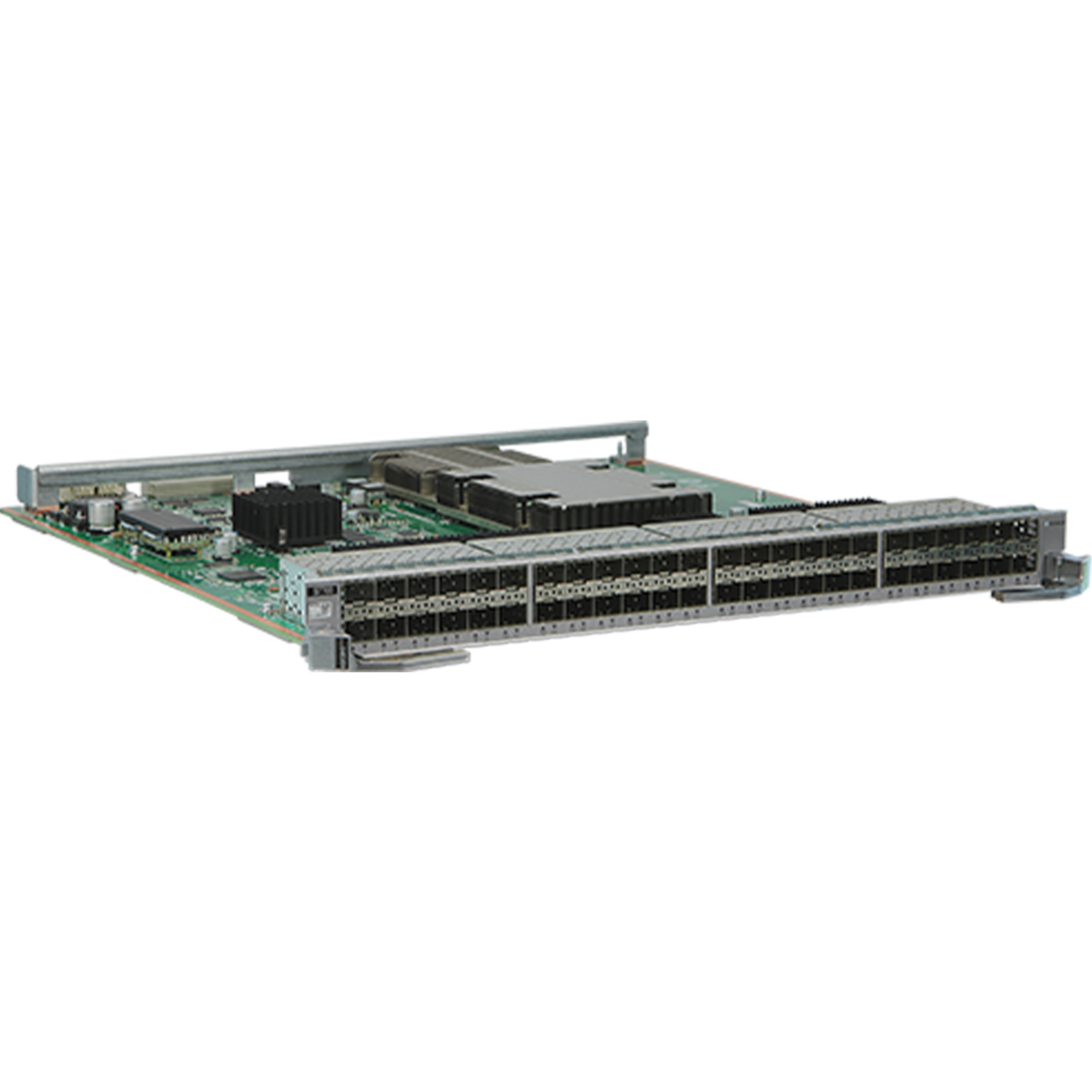
The S7700 series switches (S7700 for short) are high-end smart routing switches designed for nextgenerationenterprise networks. The S7700 design is based on Huawei’s intelligent multi-layer switching technology to provide intelligent service optimization methods, such as MPLS VPN, traffic analysis, comprehensive H-QoS policies, controllable multicast, load balancing, and security, in addition to high-performanceLayer 2 to Layer 4 switching services.
Functions of the ES1D2G48SX5H
The ES1D2G48SX5H provides the following functions:
Communicates with the MPU and works under the control of the MPU.
Searches for routes and destination addresses of data packets for forwarding.
Forwards data packets.
Optimized Solution for Enterprise Network Expansion The Huawei ES1D2G48SX5H Interface Card is engineered for enterprises and service providers requiring scalable 48-port Gigabit Ethernet access within Huawei S7700-series switch chassis. It targets network architects and engineers who demand enhanced access and aggregation capacity while maintaining system reliability. Supporting S7700, S7703, S7706, and S7712 chassis models, this module addresses high-density port growth needs in core and distribution layers. Its use is ideal for environments seeking efficient layer 2 and 3 switching with minimal operational disruption, facilitating network modernization without overhauling existing hardware infrastructures.
Advanced Technical Specifications Bolstering Network Performance Featuring 48 GE optical ports, the Huawei ES1D2G48SX5H Interface Card utilizes SFP modules supporting 10/100/1000BASE-X standards, enabling flexible fiber connections tailored to diverse distance requirements. The hot-swappable design minimizes downtime for maintenance or upgrades, ensuring high network availability. Distributed forwarding capabilities optimize throughput by balancing data flows across the forwarding plane. Compatibility with Huawei’s multi-layer switching protocols such as MPLS VPN, hierarchical QoS, and secure multicast enhances traffic management and security. Its physical dimensions and power consumption are optimized to fit seamlessly into designated slots across supported S7700 chassis variants.
Industry-Grade Integration Enhancing Data Center and Campus Networks In data centers and campus environments, the Huawei ES1D2G48SX5H Interface Card supports dense port aggregation and uplink flexibility essential for robust Layer 2 to Layer 4 connectivity. Integration with Huawei S7700 series enables enterprises to implement advanced network services including high-performance VPN traffic segmentation and real-time traffic analysis. The card’s capacity facilitates consolidation of multiple access links, reducing hardware complexity while supporting future bandwidth growth. Enterprises gain a reliable component for critical infrastructure, ensuring seamless network expansion aligned with organizational IT transformation goals.
Product Advantages
Modular Design and Compatibility Elevate System Integration The modular architecture of the Huawei ES1D2G48SX5H Interface Card supports insertion into various slots within Huawei S7700-based chassis, providing scalable deployment options and system flexibility. Its hot-swappable nature allows for card replacement or addition without powering down the system, reducing maintenance windows and operational impact. The card’s adherence to IEEE 802.3z and IP network protocols ensures interoperability and compliance with industry standards. Additionally, distributed forwarding enhances the overall chassis throughput, optimizing data plane efficiency across the network fabric.
Reliable Performance and Enhanced Operational Efficiency Designed for demanding network environments, the Huawei ES1D2G48SX5H Interface Card delivers stable and efficient data transmission via 48 Gigabit Ethernet ports, supporting SFP uplinks for adaptable fiber optics distances. Its high port density facilitates comprehensive network access and convenience in complex topologies. The card simplifies network scaling, reduces hardware footprint, and supports advanced Huawei technologies like hierarchical QoS and MPLS VPN for security and prioritized traffic handling. These features provide a robust return on investment through improved network availability, manageable upgrades, and consistent performance.
Function
Description
Basic functions
Provides forty-eight GE optical ports for data access and switching.
Distributed forwarding
Performs concurrent data forwarding using a distributed data plane.
Hot swapping
The ES1D2G48SX5H is hot swappable.
Ports on the ES1D2G48SX5H
Optical port attributes (optical module)
Attribute
Description
Connector type
SFP
Optical port attributes
Depend on the SFP optical module used.
For optical modules supported by the ES1D2G48SX5H and their attributes, see FE SFP/eSFP Optical Modules, GE eSFP Optical Modules, GE-CWDM eSFP Optical Modules, and GE-DWDM eSFP Optical Modules.
Standards compliance
IEEE 802.3z
Frame format
Ethernet_II, Ethernet_SAP, Ethernet_SNAP
Network protocol
IP
Optical port attributes (copper module)
Attribute
Description
Connector type
SFP
Optical port attributes
Depend on the SFP copper module used.
For details on the copper modules supported by the cards and attributes of the copper modules, see GE SFP Copper Modules (10 Mbit/s, 100 Mbit/s and 1000 Mbit/s rates).
Standards compliance
IEEE 802.3ab
Frame format
Ethernet_II, Ethernet_SAP, Ethernet_SNAP
Network protocol
IP
Technical specifications
Item
Description
Physical specifications
Dimensions (H x W x D): 35.1 mm x 397.2 mm x 430.4 mm (1.38 in. x 15.64 in. x 16.95 in.)
Weight: 3.3 kg (7.28 lb)
Maximum power consumption: 162 W
Use Scenarios
High-Density Access Expansion in Enterprise Campus Networks In enterprise campus environments, scaling network access points while maintaining performance is critical. The Huawei ES1D2G48SX5H Interface Card serves as a vital component within S7700-series chassis, enabling the consolidation of up to 48 Gigabit Ethernet ports for user access and distribution. Its hot-swappable design accommodates dynamic operational needs, allowing network teams to perform upgrades or replacements seamlessly. With support for Huawei’s multi-layer switching protocols and flexible SFP modules, the card ensures compliance with organizational security policies and optimized traffic management, facilitating integration into existing network architectures for cohesive system expansion.
Data Center Access Consolidation for Scalable Infrastructure In data center environments where dense Layer 2 and Layer 3 connectivity is required, the Huawei ES1D2G48SX5H Interface Card plays a critical role by providing high-density optically connected ports within the Huawei S7700 series chassis. The card supports scalable uplinks via SFP interfaces, accommodating diverse fiber distance demands and minimizing latency. Its distributed forwarding architecture balances traffic loads to maximize throughput. This integration improves switch fabric efficiency and simplifies network topology, enabling data centers to respond to increasing bandwidth requirements and evolving service needs while maintaining operational excellence and compliance with industry protocols.
ES1D2G48SX5H FAQ
Q1: Is it compatible with Huawei S9708 switches? Will there be bandwidth bottlenecks with 48 ports operating at full load simultaneously and ultra-long-distance transmission over 120km?
A1: Fully compatible! Supports the entire S9300/S9700 series, with backplane bandwidth ≥48Gbps. Full-load transmission is bottleneck-free, and the low insertion loss design ensures stable ultra-long-distance transmission, meeting cross-city access needs.
Q2: How is the signal stability when using ZE modules for 120km ultra-long-distance transmission? Is it compatible with third-party compliant SFP modules?
A2: Signal attenuation <1dB within 120km, with no packet loss or latency fluctuations. Huawei original modules are preferred, but IEEE standard third-party modules are also compatible, offering flexible adaptation and controllable costs.
Q3: How to choose between 24/32-port / standard long-distance high-end line boards?
A3: 24 ports are suitable for <30 devices, 32 ports are suitable for 30-40 devices, and the standard long-distance model only supports ≤80km; for more than 40 devices and ultra-long-distance requirements of 80km-120km, this product offers the best cost performance.
Optical Modules Supported by Huawei S Series Switches