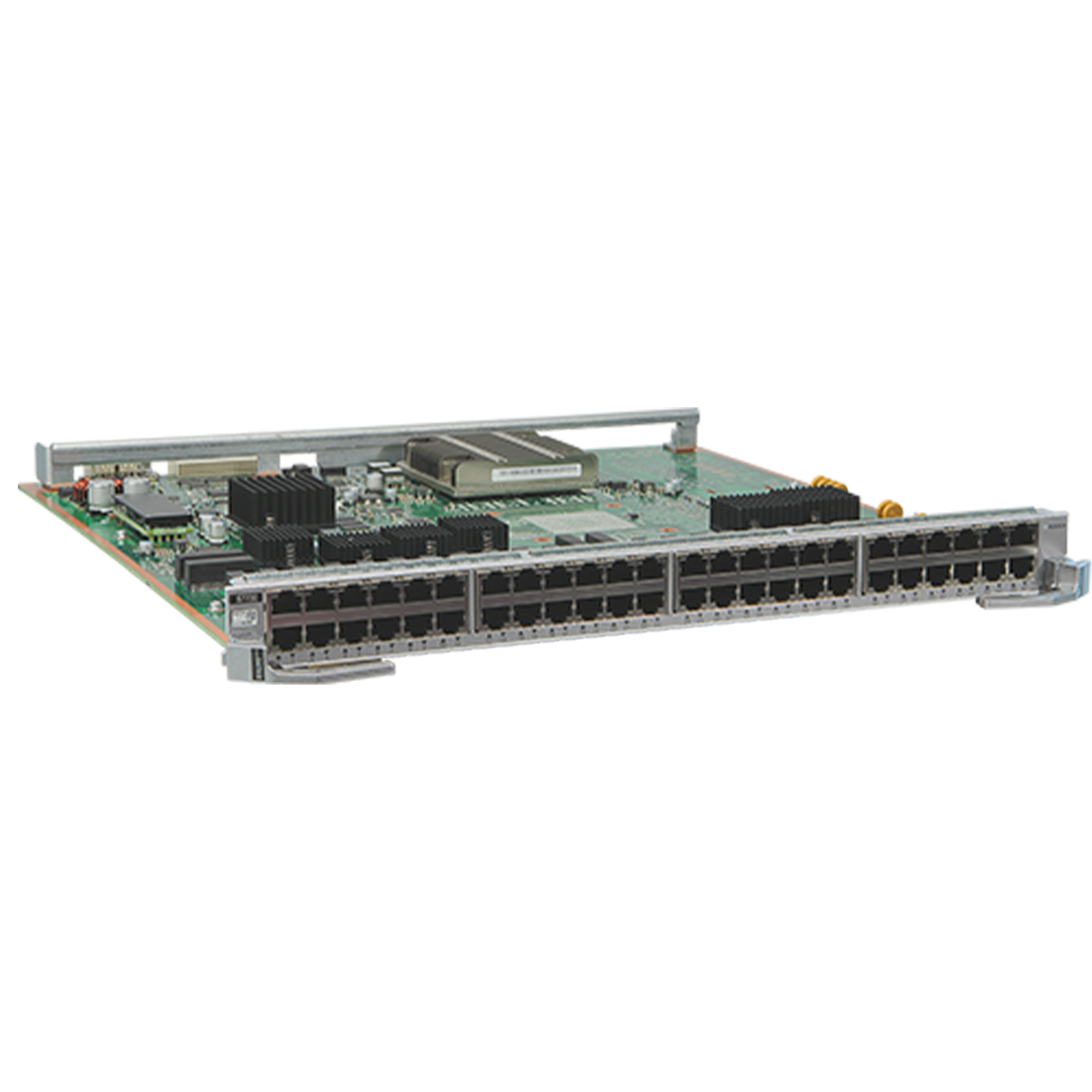
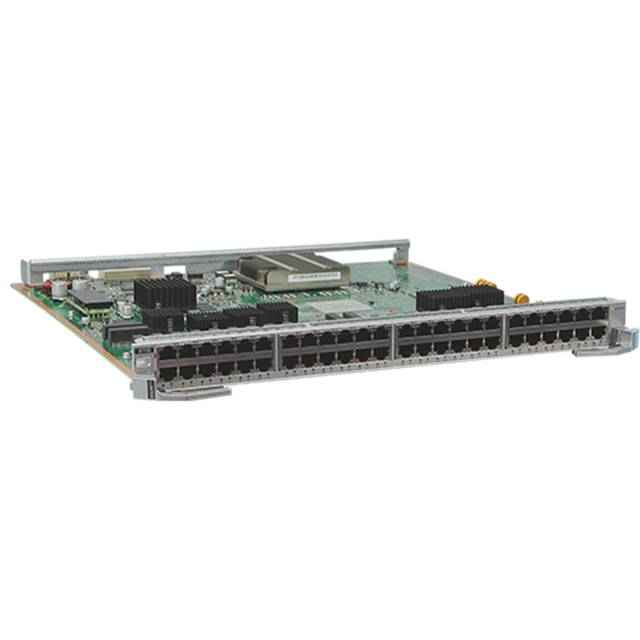
The S7700 series switches (S7700 for short) are high-end smart routing switches designed for nextgenerationenterprise networks. The S7700 design is based on Huawei’s intelligent multi-layer switching technology to provide intelligent service optimization methods, such as MPLS VPN, traffic analysis, comprehensive H-QoS policies, controllable multicast, load balancing, and security, in addition to high-performanceLayer 2 to Layer 4 switching services.
Functions of the ES1D2G48TX5H
The ES1D2G48TX5H provides the following functions:
Communicates with the MPU and works under the control of the MPU.
Searches for routes and destination addresses of data packets for forwarding.
Forwards data packets.
Functional Positioning for Enterprise Network Expansion The Huawei ES1D2G48TX5H Interface Card addresses the demands of enterprise IT infrastructure requiring scalable access-layer connectivity. Designed as a 48-port 100/1000BASE-T RJ45 interface card, it is compatible with Huawei S7700 series chassis including S7703, S7706, and S7712 models. This solution targets network engineers and procurement managers who need to increase port density without system downtime. Its hot-swappable design facilitates maintenance or upgrades without interrupting active traffic, supporting uninterrupted operational continuity. The card’s integration with Huawei’s intelligent multi-layer switching platform enables robust delivery of Layer 2 through Layer 4 services within complex enterprise environments.
Technical Features and Industry-Standard Specifications Equipped with 48 electrical GE ports conforming to IEEE 802.3ab standards, the Huawei ES1D2G48TX5H Interface Card supports 100/1000Mbps transmission over copper RJ45 connectors. Its physical dimensions of approximately 35.1 mm x 397.2 mm x 430.4 mm and power consumption of up to 107W are optimized for hot-swap compatibility in multiple slot configurations on permitted S7700 chassis. The interface card supports multiple Ethernet frame formats including Ethernet II, SAP, and SNAP, ensuring protocol flexibility for IP traffic. These specifications guarantee stable, high-throughput data access, with the capacity to implement advanced features such as MPLS VPN, comprehensive H-QoS policies, controllable multicast, and multilayer security within enterprise and data center networks.
Industry Applications Enhancing Network Infrastructure The Huawei ES1D2G48TX5H Interface Card is integral in enterprise networks requiring dense Gigabit Ethernet port expansion. It serves to augment Huawei S7700 switch deployments used in corporate campus networks, data centers, and service provider access layers. By enabling flexible port expansion through seamless hot-swapping, the card supports zero downtime upgrades critical for mission-critical networks. Its compatibility with Huawei’s advanced switching technology facilitates deployment of VPNs, traffic analytics, and security policies, enhancing overall network performance, scalability, and operational reliability. This interface card provides a cost-effective approach to expanding existing infrastructure while maintaining compliance and stability in complex multi-layer environments.
Product Advantages
Structural and Modular Design Benefits The Huawei ES1D2G48TX5H Interface Card is engineered with modularity and structural integration as priorities, enabling installation across multiple slot configurations on Huawei S7700 chassis models S7703, S7706, and S7712. This modular design supports flexible port density scaling from 48 ports upward, without requiring chassis replacement. The card’s adherence to hot-swappable architecture minimizes network disruption during maintenance or upgrades. Employing standardized RJ45 copper interfaces ensures compatibility with existing Ethernet cabling infrastructure, reducing integration complexity. Additionally, its compliance with industry physical and environmental standards—including form factor, power consumption, and thermal parameters—guarantees reliable operation within diverse enterprise network environments.
Enhanced Performance and Operational Usability Performance-wise, the Huawei ES1D2G48TX5H Interface Card delivers consistent 1 Gbps throughput per port, supporting high-density Ethernet access with stable, low-latency connectivity. Its compatibility with Huawei’s intelligent multi-layer switching technologies enhances L2 through L4 service processing, enabling advanced features such as traffic prioritization and multicast control. The hot-swappable capability significantly improves operational usability by eliminating downtime for module replacement or expansion. This reduces total cost of ownership by protecting network availability and streamlining maintenance workflows. For network administrators, the card’s plug-and-play installation and proven compatibility with S7700 series chassis simplify deployment and scalability planning within enterprise-grade infrastructure.
Function
Description
Basic functions
Provides forty-eight GE electrical ports for data access and switching.
Distributed forwarding
Performs concurrent data forwarding using a distributed data plane.
Hot swapping
The ES1D2G48TX5H is hot swappable.
Ports on the ES1D2G48TX5H
Attribute
Description
Connector type
RJ45
Standards compliance
IEEE 802.3ab
Frame format
Ethernet_II, Ethernet_SAP, Ethernet_SNAP
Network protocol
IP
Technical specifications
Item
Description
Physical specifications
Dimensions (H x W x D): 35.1 mm x 397.2 mm x 430.4 mm (1.38 in. x 15.64 in. x 16.95 in.)
Weight: 3.3 kg (7.28 lb)
Maximum power consumption: 107 W
Use Scenarios
Access Layer Expansion in Enterprise Data Centers In modern enterprise data centers, high-density port availability is critical to accommodate growing demands for server and storage connectivity. The Huawei ES1D2G48TX5H Interface Card plays a pivotal role by providing 48 high-speed 100/1000BASE-T ports within the S7700 switch family, enabling scalable and consolidated copper-based network access. Its compliance with IEEE 802.3ab standards ensures interoperability with diverse endpoints and cabling. The hot-swappable feature allows data center operators to expand or replace interface modules without interrupting services, supporting strict uptime requirements. Integrating seamlessly with Huawei’s multi-layer switching platform, the card enables robust traffic engineering, security policy implementation, and MPLS VPN support within the data center fabric, optimizing resource utilization and network resilience.
Deployment in Large Enterprise Campus Networks Within expansive enterprise campus environments, network infrastructure must sustain scalable port density and flexible connectivity. The Huawei ES1D2G48TX5H Interface Card fulfills this operational role by delivering 48 RJ45 Gigabit Ethernet ports that can be deployed across various S7700 switch slots to match site-specific capacity needs. The product’s high-density copper connectivity supports connectivity for a broad range of enterprise devices such as workstations, IP phones, and access points, while maintaining compatibility with existing Ethernet standards. Its robust design and hot-swappable capability reduce maintenance windows and improve fault tolerance. The interface card integrates with Huawei’s switching technology to support quality of service parameters and multicast traffic controls, ensuring efficient bandwidth management and security compliance in complex corporate network environments.
ES1D2G48TX5H FAQ
Q1: Is it compatible with Huawei S9708 switches? Is there any risk of failure when operating 48 ports simultaneously under full load and extreme temperatures (-55℃/85℃)?
A1: Fully compatible! Supports the entire S9300/S9700 series, backplane bandwidth ≥48Gbps, no bottlenecks under full load transmission, ultra-wide temperature range + tri-proof construction, no risk of failure under extreme temperatures, meeting special industry-level requirements;
Q2: How is the transmission stability at 55m when using Cat.5e copper cable to connect to mine monitoring equipment? What is the difference between the ultra-wide temperature range and the regular wide temperature range version?
A2: Signal attenuation <0.25dB within 55m, no packet loss; ultra-wide temperature range -55℃~85℃, 25% wider than the regular wide temperature range version (-40℃~70℃), adapting to more stringent extreme environments, compatible with IEEE standard terminals;
Q3: How to choose between 24/32 port / regular wide temperature range high-end circuit boards?
A3: 24 ports are suitable for <30 devices, 32 ports are suitable for 30-40 devices, and the standard wide-temperature version is suitable for scenarios of -40℃~70℃; for more than 40 devices and ultra-extreme temperature (<-40℃ or >70℃) requirements, this product has the best compatibility.
Optical Modules Supported by Huawei S Series Switches